
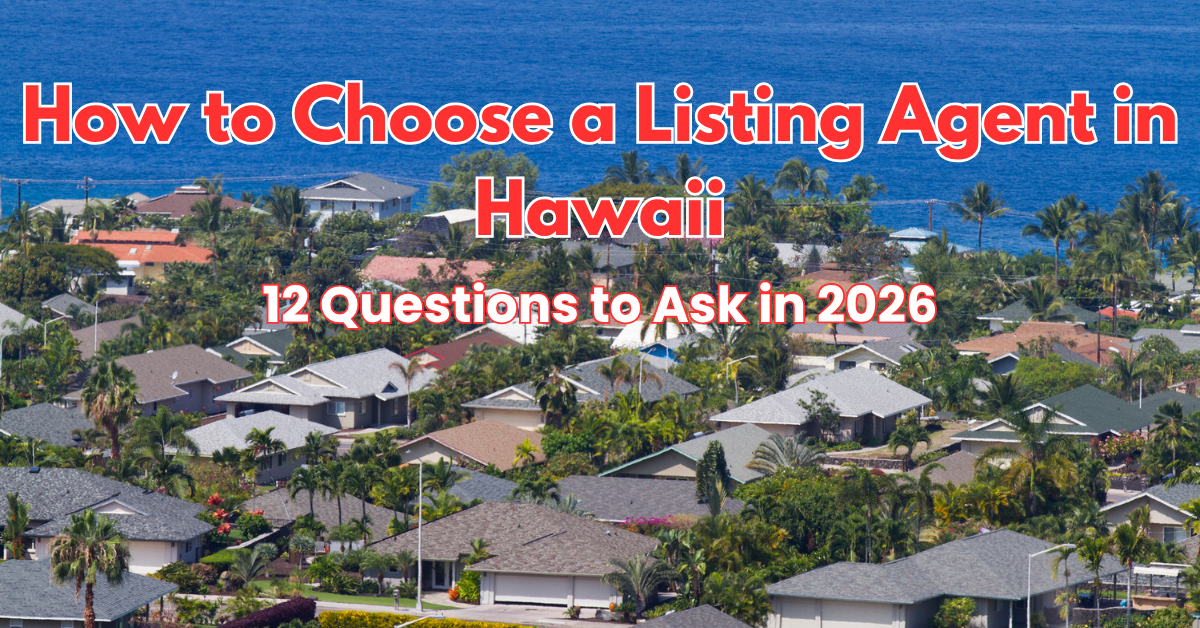
How to Choose a Listing Agent in Hawaii: 12 Questions to Ask in 2026
Selling a home in Hawaii is unlike selling property anywhere else in the United States. Between unique microclimates, hyper-local neighborhood dynamics, strict state disclosure laws, and an influx of out-of-state buyers, island real estate requires a specialized skill set. Whether you are selling a single-family home in Kailua, a luxury condominium in Kakaako, a coffee farm in Kona, or a plantation-style property on Kauai, hiring the right professional makes a measurable difference in your final net proceeds and overall stress level.
Take the Quiz: Is Hawaii Right For You? Meet with a Living in Hawaii Expert!
Many homeowners start their search by asking friends for recommendations or clicking on the first agent they see on social media. While personal referrals can be a helpful starting point, selecting someone to represent your largest financial asset demands a rigorous interview process. The real estate market in 2026 brings new regulations regarding buyer-broker compensation, shifting buyer demographics, and changing interest rate environments that affect purchasing power across all islands.
To help you navigate this important decision, we have compiled the definitive guide on how to choose a real estate agent in Hawaii. These twelve vetted questions will help you separate average agents from top-tier professionals who understand how to position, market, and negotiate your property for maximum return.
1. What Is Your Track Record in My Specific Neighborhood and Island Micro-Market?
Hawaii real estate is hyper-local. Market conditions in West Maui can be completely different from Upcountry Maui, just as buyer demand in Ewa Beach operates on entirely different economics than Diamond Head or the North Shore of Oahu. When evaluating an agent, you need to know their direct experience within your specific zip code, subdivision, or condominium complex.
An agent who primarily sells downtown Honolulu condos may not understand the nuances of cesspool conversion regulations on the Big Island, agricultural zoning restrictions on Kauai, or private road maintenance agreements in rural Oahu. Ask candidates how many homes they have sold in your immediate neighborhood over the past two years, what their average days on market were, and how their final sale prices compared to the original list prices.
A true local expert should be able to rattle off recent neighborhood comps, explain why a home down the street sat on the market for six months, and identify the exact buyer profile most likely to pay top dollar for your specific floor plan or lot configuration.
2. How Do You Determine List Price in Today’s Market?
Pricing strategy is both an art and a science in Hawaii. Some agents use an unethical tactic known as “buying a listing,” where they intentionally present an inflated, unrealistic valuation simply to win your business. Months later, after the property sits stagnant, they demand steep price reductions, leaving your listing stale and vulnerable to lowball offers.
Ask each agent to walk you through their Comparative Market Analysis (CMA) step by step. Look for an agent who grounds their pricing recommendations in hard data, including recent closed sales, pending transactions, active competition, and seasonal absorption rates.
A top listing agent will present a clear bracket: a conservative baseline value, a target market price, and an aggressive reach price. They should explain the exact risks and benefits associated with each approach based on prevailing buyer demand in your price tier.
3. What Is Your Marketing Strategy Beyond the MLS?
Putting a property on the local Multiple Listing Service (MLS) and putting a sign in the yard is the bare minimum. In 2026, an effective listing campaign requires a multi-layered digital and traditional marketing strategy designed to capture local, Mainland, and international buyers.
Ask prospective agents for concrete examples of recent marketing campaigns. Their plan should include high-definition architectural photography, cinematic video walk-throughs, dedicated property websites, targeted social media advertising campaigns, email marketing to top-producing buyer agents across the state, and print collateral that reflects the quality of your home.
Inquire specifically about how they showcase unique property attributes. Island properties often feature ocean views, tradewind ventilation, indoor-outdoor lanai living, or mature fruit trees that cannot be captured effectively by basic point-and-shoot photography. Your agent should invest in twilight photography and FAA-licensed drone footage where appropriate.
4. How Do You Reach and Convert Mainland and Relocating Buyers?
Depending on your island and price point, a substantial percentage of qualified buyers may be relocating from the Mainland or overseas. These buyers face distinct logistical hurdles, including time zone differences, unfamiliarity with island living, and the challenge of evaluating properties remotely.
Ask the agent how they market directly to out-of-state buyers. Do they maintain relationships with relocation networks, military housing coordinators, or Mainland brokerages? Do they provide immersive 3D virtual tours (such as Matterport) and high-touch FaceTime or Zoom walk-throughs for long-distance prospects?
An experienced agent knows how to speak to Mainland buyers about island realities, such as salt-air maintenance, solar PV systems, HOA rules, and climate zones, answering their questions proactively so transactions do not fall apart during the due diligence period.
5. How Will You Guide Me Through Hawaii-Specific Disclosure Requirements?
Hawaii has some of the strictest seller disclosure laws in the nation under Hawaii Revised Statutes Chapter 508D. Sellers are legally required to disclose all material facts regarding the physical condition of the property, neighborhood nuisances, boundary disputes, permitting issues, and environmental hazards.
Failure to complete disclosure documents accurately can lead to costly escrow cancellations or post-closing lawsuits. Ask the agent how they assist sellers with the Real Property Disclosure Statement. While an agent cannot legally fill out the form for you, an experienced professional will guide you through common red flags, such as unpermitted additions, lava zones, flood zones, tsunami evacuation areas, shoreline setback rules, and termite inspection histories.
Understanding how disclosures impact the overall transaction schedule is essential. Ask each candidate to map out the milestones between listing day and closing day so you know exactly when your disclosure deadlines land.
6. What Is Your Understanding of HARPTA and FIRPTA Withholding Rules?
Tax withholding requirements in Hawaii catch many out-of-state and international sellers completely off guard. Under the Hawaii Real Property Tax Act (HARPTA), the State of Hawaii requires buyers to withhold a percentage of the total sales price at closing if the seller is not a resident of Hawaii, unless a valid exemption certificate is obtained.
Similarly, the Foreign Investment in Real Property Tax Act (FIRPTA) enforces federal withholding for foreign property owners. While real estate agents are not certified public accountants or tax attorneys, your listing agent must possess a clear operational understanding of these regulations so escrow proceeds smoothly.
Your listing agent should know how to coordinate with your escrow officer and tax professional early in the listing process to prepare necessary exemption forms (such as Form N-288 or Form N-289) well before closing day arrives.
7. Who Exactly Will Be Managing My Listing and Communicating With Me?
When you interview a prominent “mega-agent” or team lead, you might assume that person will be personally handling every detail of your sale. In reality, many high-volume agents hand off day-to-day operations, open houses, and client communication to junior associates or administrative assistants as soon as the listing agreement is signed.
Clarify this upfront by asking:
- Will you personally host open houses and private showings, or will team members step in?
- Who will be my primary point of contact during the escrow process?
- How often will I receive status updates, showing feedback, and marketing analytics?
- What communication channels do you use most often (phone, text, email, or weekly video calls)?
Neither a solo agent nor a large team is inherently better, but you deserve full transparency regarding who will represent your home to prospective buyers and who will negotiate on your behalf when offers come across the table.
8. What Is Your Strategy for Staging and Property Preparation?
Preparing an island home for the market requires a balanced touch. Island buyers look for breezy, open, clutter-free spaces that highlight natural light and outdoor vistas. Heavy, dark furniture, excessive knick-knacks, or dated window coverings can make a tropical home feel cramped and dim.
Ask the agent for their assessment of your home in its current state. Do they offer professional staging services, partial staging consultations, or virtual staging for vacant spaces? Can they connect you with trusted local contractors, handymen, painters, landscapers, and deep-cleaners who can prepare the home quickly?
An exceptional agent will provide a tailored punch list of high-ROI improvements, such as power-washing driveways, refreshing landscaping with native plants, painting neutral interiors, or repairing deck railings, that yield the greatest financial return without over-improving the space.
9. How Do You Navigate Condominium and HOA Nuances?
If you are selling a condominium, townhome, or a property located within a planned community (such as Mililani Mauka, Princeville, or Waikoloa Village), the sales process involves substantial paperwork and association scrutiny.
Buyers have statutory review periods to inspect condo documents, including association budgets, reserve studies, meeting minutes, house rules, insurance certificates, and pending special assessments. If an association is underfunded or facing major capital improvement projects (such as spalling repairs or plumbing retrofits), prospective buyers may struggle to secure conventional financing.
Ask the agent how familiar they are with your building or community association. Have they recently reviewed the reserve study or building financials? Do they know which lenders on the island are currently approving mortgages for your specific development? An experienced condo listing agent solves lending and association hurdles before they threaten your sale.
10. What Is Your Commission Structure and Agreement Terms?
Real estate commission structures have evolved significantly across the country following national antitrust settlements. Real estate commissions are negotiable by law, and transparency regarding professional fees is paramount.
Ask prospective agents to break down their total fee structure clearly:
- What is your listing fee, and what specific services are covered under that rate?
- What strategy do you recommend regarding offering cooperative compensation to buyer brokerages to maximize market exposure?
- Are there any administrative, photography, or transaction coordination fees billed separately?
- What is the length of the listing agreement, and what is your policy regarding early cancellation if I am unhappy with your performance?
A reputable agent will be completely comfortable discussing fees, explaining the distinct value they deliver for their commission, and offering flexible, fair agreement terms with clear performance standards.
11. How Do You Handle Complex Offer Negotiations and Escrow Hurdles?
Securing an accepted purchase contract is only the halfway mark in a Hawaii real estate transaction. The real work begins during the escrow period, which typically spans 30 to 60 days depending on financing arrangements.
During this window, transactions face potential roadblocks, including home inspection repair demands, boundary staking discrepancies, low bank appraisals, and loan condition delays. Ask candidates to share a specific example of an escrow that encountered severe challenges and how they navigated the situation to protect their seller’s earnest money deposit and closing timeline.
Look for strong negotiation instincts. You want an advocate who knows when to hold firm, when to offer creative credits instead of price cuts, and how to maintain buyer momentum without sacrificing your financial bottom line.
12. Can You Provide Three References From Recent Island Sellers?
Online reviews on third-party portals can provide general insights, but speaking directly with previous clients gives you genuine perspective on what it feels like to work with an agent under pressure.
Request contact details for three sellers the agent represented within the past twelve months, ideally involving homes with similar price points or locations to yours. When you talk story with those references, ask key questions:
- Did the agent deliver on the marketing promises they made during the initial presentation?
- How well did they communicate when unexpected challenges arose during escrow?
- Did they negotiate firmly on your behalf, or did they pressure you to accept a lower offer just to close the deal?
- Would you hire this agent again without hesitation?
An agent who hesitates to provide references or only offers testimonials from several years ago should raise an immediate red flag.
Summary: Checklist for Interviewing Hawaii Listing Agents
To keep your agent interviews organized, use this quick reference checklist as you compare candidates:
- Hyper-Local Sales History: Verifiable closed volume in your neighborhood or condo project.
- Data-Backed Pricing Strategy: Comprehensive market analysis detailing conservative, target, and reach figures.
- Multi-Channel Marketing: High-end photography, drone video, 3D tours, and targeted digital advertising.
- Mainland Outreach: Proven systems to attract, educate, and convert long-distance relocation buyers.
- Regulatory Mastery: Thorough understanding of Hawaii Chapter 508D disclosure laws, zoning, and environmental zones.
- Tax Familiarity: Working knowledge of HARPTA and FIRPTA withholding processes.
- Clear Communication: Defined update schedules and transparent points of contact.
- Preparation Guidance: Hands-on advice for staging, repairs, and curb appeal enhancements.
- HOA Competence: Experience navigating condo reserves, house rules, and lender project approvals.
- Transparent Commission: Clear breakdown of service costs, co-op strategies, and cancellation policies.
- Tenacious Negotiation: Proven ability to overcome low appraisals, inspection disputes, and repair credits.
- Verified References: Positive feedback from recent island sellers who were in your shoes.
Selling your island home is a milestone event. By taking the time to interview multiple candidates and asking these twelve targeted questions, you can partner with a dedicated professional who protects your interests, maximizes your net proceeds, and guides you through a seamless closing.
Leave A Comment