

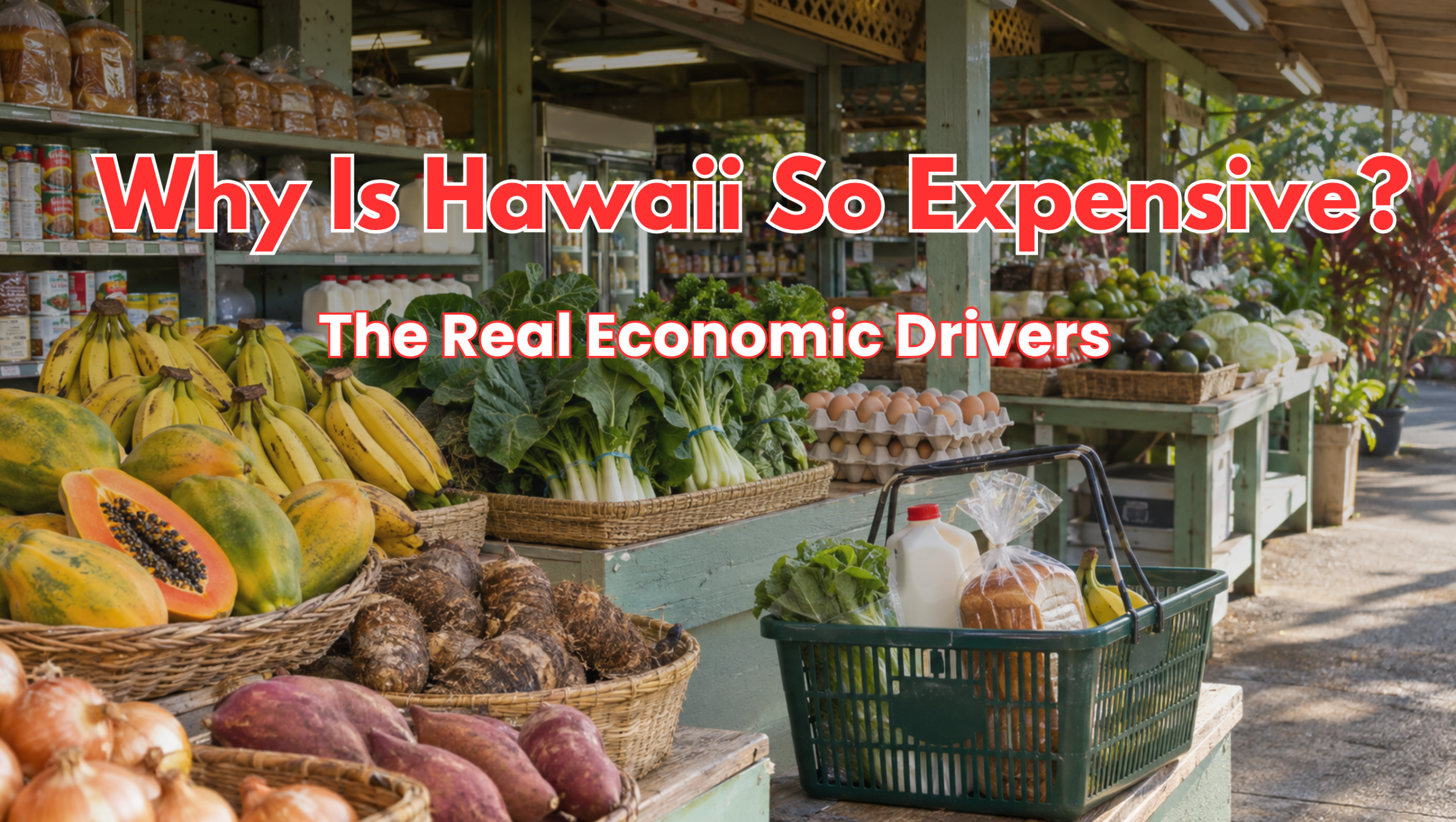
Why Is Hawaii So Expensive? The Real Economic Drivers
Anyone considering a move to the islands quickly encounters the numbers. Median home prices consistently hover around one million dollars on Oahu and Maui, a single gallon of conventional milk can reach eight or nine dollars at a neighborhood store, and monthly electric bills often shock newcomers accustomed to mainland rates. It is easy to write off these figures as an arbitrary tax on sunshine, but the true drivers of Hawaii’s elevated cost of living are structural, legal, and geographic.
Take the Quiz: Is Hawaii Right For You? Meet with a Living in Hawaii Expert!
Understanding these underlying economic forces changes how you evaluate a potential move. When you understand why goods, services, and shelter cost what they do, you can budget realistically, build sustainable financial habits, and avoid the sticker shock that drives unprepared transplants back to the Mainland within two years. Here is a clear, unvarnished look at the real reasons Hawaii carries the highest cost of living in the United States.
The Geography of Extreme Geographic Isolation
The fundamental driver of consumer pricing in Hawaii begins on the map. The Hawaiian archipelago is the most isolated population center on the planet, situated roughly 2,400 miles from the western coastline of the continental United States and nearly 4,000 miles from Japan. This isolation creates an unavoidable reliance on long-distance logistics that touches every physical product sold across the state.
Hawaii imports between 85% and 90% of its food, along with almost all of its manufactured goods, construction supplies, medical equipment, vehicles, and raw energy inputs. When an item sits on a shelf in Honolulu, Kahului, or Hilo, that item has already incurred ocean transit expenses, port handling fees, dock labor costs, and fuel surcharges. Unlike a landlocked mainland city where distribution hubs can quickly reroute freight via interstate trucking corridors, Hawaii relies entirely on maritime shipping routes and limited air cargo.
Furthermore, goods destined for neighboring islands like Kauai, Maui, Molokai, Lanai, and the Big Island must undergo a secondary voyage via inter-island barge operations. This hub-and-spoke distribution model means products arrive in Honolulu first at the Sand Island shipping terminals, get broken down, reloaded onto barges, and shipped across open channels. Every additional handling step adds labor, fuel, and storage charges that get passed down directly to the consumer at the checkout counter.
The Realities of Maritime Freight and the Jones Act
Ocean freight logistics into Hawaii operate under a specific federal regulatory framework known formally as the Merchant Marine Act of 1920, commonly called the Jones Act. This statute requires that all maritime cargo transported between two United States ports must be carried on ships that are built in the United States, flagged under the American banner, and owned and crewed predominantly by United States citizens.
The economic impact of this regulation is a regular topic of discussion among economists and policy analysts. While intended to maintain a strong domestic merchant marine fleet for national defense purposes, American-built cargo vessels are significantly more expensive to construct and maintain than foreign-built equivalents. American maritime labor standards and operating requirements also run significantly higher than foreign flag-of-convenience vessels.
Because international vessels traveling across the Pacific cannot pick up goods in California and offload them in Honolulu without violating the Jones Act, mainland-to-Hawaii commercial ocean routes are dominated by a small number of domestic container carriers. This limits direct price competition on shipping routes. While shipping companies point out that their dedicated fleets provide reliable, scheduled service tailored to island inventory needs, the compliance costs and capital expenditures inherent to the domestic shipping fleet inevitably filter into the final price of everything from lumber to breakfast cereal.
For household budgets, this constant logistics markup means grocery bills routinely sit 50% to 70% above national averages. Families moving from the Mainland often need to dramatically recalibrate their spending, a process outlined in our guide on Hawaii grocery strategies and where to find the best prices.
Strict Land Use Policies and Severe Housing Scarcity
Housing represents the largest monthly expenditure for Hawaii residents, and the root causes of the state’s housing crisis lie in zoning restrictions, physical topography, and historical land ownership structures. Hawaii has some of the most stringent land management regulations in the country.
Under the Hawaii State Land Use Law passed in 1961, all land in the state is divided into four distinct classifications: Conservation, Agricultural, Rural, and Urban. Only land classified as Urban can be developed for standard residential and commercial use. Crucially, less than 5% of the total land area across the entire island chain is designated as Urban. The vast majority of the islands consists of protected watersheds, steep volcanic mountain ranges, forest reserves, and designated agricultural parcels.
Beyond state classifications, development projects must navigate county-level zoning codes, community plans, and the State Land Use Commission. Reclassifying agricultural parcels into urban parcels is an exhaustive, multi-year process that requires extensive environmental impact statements, community hearings, and infrastructure commitments. By the time a developer completes the entitlement process, carrying costs and legal fees have added substantial premiums to every planned rooftop.
Land ownership is also heavily concentrated. Between the State of Hawaii, the federal government, and a handful of historic private trusts and large estates, a small number of entities control the overwhelming majority of acreage. Because large landowners historically leased ground rather than selling it fee-simple, developable fee-simple private land remains extraordinarily limited. When demand from incoming residents, military assignments, and external investors collides with a structurally fixed supply of buildable parcels, market prices rise aggressively.
Construction Costs and the Permitting Bottleneck
Even when residential land is secured, building a home in Hawaii costs significantly more than almost anywhere else in North America. Construction materials, including framing lumber, structural steel, concrete aggregates, plumbing pipes, drywall, and electrical wiring, must be shipped across the ocean in standard shipping containers. Local suppliers cannot quickly absorb supply chain disruptions, leading to material delays and inflated carrying costs for builders.
Labor dynamics compound the problem. The state has a chronic shortage of licensed trade contractors, electricians, plumbers, and skilled carpenters. Because the local cost of living affects trade workers just as much as anyone else, hourly labor rates for licensed contractors reflect those high expenses. In many neighborhoods across Oahu and Maui, standard residential construction costs range between $400 and $800 or more per square foot for basic to mid-tier finishes, excluding the purchase price of the underlying dirt.
Finally, municipal permitting departments face historic backlogs. In the City and County of Honolulu, obtaining residential building permits for new construction or substantial renovations can take anywhere from six months to well over a year. During that waiting window, owners pay property taxes, loan interest, and design retainers while waiting for authorization to pour concrete. Those holding costs inevitably translate into higher sales prices and elevated rental rates across the entire inventory spectrum.
Energy Generation on Island Microgrids
Utility bills represent another substantial source of expense for island residents. Hawaii’s electricity rates are consistently the highest in the country, often running between three and four times the national average. Rates routinely hover between 38 and 44 cents per kilowatt-hour, compared to a mainland baseline that often sits around 12 to 16 cents.
The explanation lies in how Hawaii generates power. The islands have no interstate electricity grid to tap into for cheap baseload power during peak hours. Each populated island operates as an isolated electrical microgrid that must balance its own generation and demand minute by minute without backup support from neighboring grids.
Historically, Hawaii relied almost entirely on imported petroleum and fuel oil to run heavy electrical turbines. While the state has made massive strides toward clean energy mandates, integrating variable renewable sources like utility-scale solar and wind onto isolated island grids requires significant capital investments in battery energy storage systems, grid modernization, and dynamic control hardware. The debt service and maintenance costs for this modernization work are reflected on monthly utility bills.
Water and sewer systems face comparable geographical hurdles. Pumping fresh water from deep volcanic basal aquifers to hillside residential subdivisions requires significant electrical power. Maintaining aging water transmission pipes through corrosive volcanic soils and coastal salt air requires continuous maintenance. Anyone setting up a household should factor in these operational overheads early, as detailed in our breakdown of Hawaii utility setup costs and operational fees.
The General Excise Tax and Tax Pyramiding
Hawaii does not have a traditional retail sales tax. Instead, the state relies on a General Excise Tax, commonly referred to as the GET. While consumers often see the GET added at the register just like a sales tax, the fundamental mechanics of the tax operate quite differently.
The GET is a tax levied on the gross income of businesses for the privilege of conducting business in Hawaii. It applies to virtually all commercial activities, including retail sales, wholesale transactions, rental income, professional services, and construction contracting. On Oahu, the base state GET rate of 4% combines with a county surcharge for a total effective rate of 4.5% at point of sale, with Neighbor Islands sitting between 4% and 4.712%.
The critical factor is what economists call tax pyramiding. Because the GET applies to every stage of a commercial transaction, taxes accumulate as goods move through the supply chain. For example, when a distributor sells building materials to a subcontractor, GET is paid. When the subcontractor bills the general contractor, GET is paid again. When the general contractor invoices the homeowner, GET is paid a third time. This compounding tax structure embeds costs into the final prices of goods and services long before the final retail transaction occurs.
The Gap Between Local Wages and Essential Living Expenses
The challenge of Hawaii’s cost of living is not solely about elevated prices. It is about the relationship between prices and local earning power. Hawaii’s economy lacks the broad industrial diversification found in major mainland metropolitan centers.
The largest sectors driving the state economy are hospitality and tourism, defense spending, healthcare, and state government. While these sectors provide steady employment, their wage growth has historically lagged behind the hyper-inflation of housing and consumer staples. Professional salaries in finance, corporate enterprise, and technology often fall 10% to 25% below what comparable roles pay in major West Coast hubs like Seattle, San Francisco, or San Diego, despite the reality that everyday groceries and utilities cost substantially more in Honolulu.
This structural gap creates the local economic reality known as the sunshine tax, where professionals accept lower real compensation in exchange for island lifestyle benefits. For long-time residents, bridging this gap typically involves multi-generational family living arrangements, side ventures, or holding multiple jobs. For single-income transplant households relying strictly on local payrolls, making the budget balance can prove challenging.
Vehicle Ownership, Fuel, and Island Infrastructure
Day-to-day transportation on the islands introduces additional financial drag. Because Hawaii must import refined gasoline and diesel across the Pacific, pump prices are regularly among the highest in the country, competing with California for the top spot. Island roads also take a heavy toll on vehicles due to constant UV exposure, high humidity, salt-laden marine air, and rough volcanic pavement.
Purchasing a vehicle carries an island markup because auto dealerships must pay ocean freight to bring inventory to Hawaii docks. Replacement parts, routine tire changes, and mechanical repairs also reflect logistics premiums and elevated shop labor rates. Furthermore, annual vehicle registration fees in Hawaii counties incorporate weight-based taxes that make registering light trucks and larger SUVs noticeably pricier than on the Mainland. Anyone planning to keep a vehicle running smoothly should review the full picture laid out in our guide to the cost of car ownership in Hawaii.
How Residents Adapt to Island Financial Realities
Living successfully in Hawaii over the long haul requires abandoning mainland consumer defaults and adopting an intentional island lifestyle. The residents who thrive here for decades do not simply absorb mainland-style spending at double the price. They adapt how they shop, live, and allocate their resources.
First, households lean heavily into buying non-perishables and bulk household staples at warehouse clubs like Costco, which operates some of its highest-volume locations in the world on Oahu and Maui. Fresh produce is sourced from local farmers markets, small fruit stands, or community gardens where seasonal island crops like papaya, bananas, avocados, and greens bypass ocean freight markups entirely.
Second, homeowners prioritize residential solar photovoltaic installations paired with battery energy storage. Given the abundance of sunlight and the extraordinary cost of grid power, rooftop solar systems deliver some of the fastest return-on-investment timelines in the country, effectively locking in long-term electricity expenses.
Finally, successful transplants adjust their physical expectations. Mainland notions of large single-family homes with sprawling yards give way to a lifestyle focused on the natural environment. In Hawaii, living space extends outdoors to the beach, the hiking trail, and the lanai. When you spend your leisure hours outside rather than maintaining a large house or accumulating consumer items that require shipping and storage, the cost of living shifts from an insurmountable barrier into a manageable, deliberate equation.
Leave A Comment