

Where People Are Moving in Hawaii in 2026: Migration Trends & Hotspots
The “Hawaii Dream” isn’t static. If you looked at a migration map in 2015, the arrows pointed squarely at Waikiki, Kaka‘ako, and Kailua. But in 2026, the map has fundamentally shifted. We are witnessing a decentralization of the population, driven by three massive forces: the maturity of remote work, the “Insurance Crunch” affecting older condos, and a hunger for land that “Town” (Honolulu proper) simply cannot satisfy.
This isn’t just about where people are buying; it’s about why. Are they moving for the new rail stations? Are they fleeing rising HOA fees? Or are they simply following the fiber-optic cables to the rainforest?
Key Takeaways / TL;DR:
* The “Second City” is #1: Ewa Beach and Kapolei are now the primary destination for young families, surpassing Honolulu.
* The Big Island Shift: Pahoa is no longer just for retirees; it’s a remote-work boomtown.
* The Exodus: Older condos in Mauka Waikiki are seeing vacancies due to special assessments (spalling).
* The “Starlink” Effect: Remote executives are pushing into previously “off-grid” areas of Kauai’s North Shore.
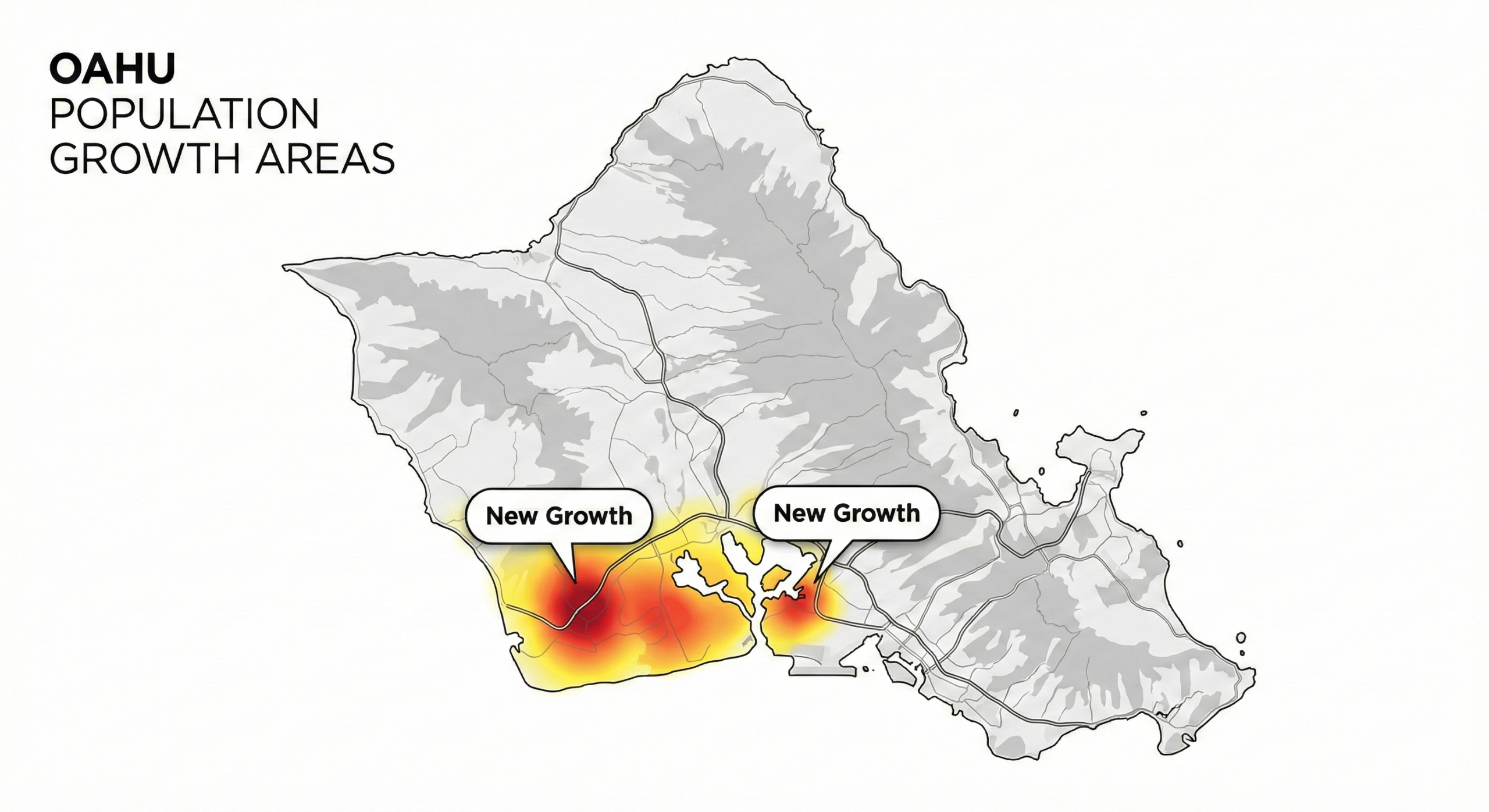
Trend #1: The West Oahu Takeover (Ewa Beach & Kapolei)
The What
For decades, Ewa Beach and Kapolei were considered “bedroom communities”—places you slept, but left every morning to drive into town for work. In 2026, that narrative is dead. These areas have evolved into self-sustaining metropolises. The data shows that for every 10 families moving to Oahu from the Mainland this year, 6 are landing in the Ewa Plain.
The Why
The drivers here are infrastructure and inventory age.
1. The Rail & Road: The Skyline rail system is now fully operational to Kaka‘ako, changing the psychological distance of the commute.
2. Commercial Gravity: With Ka Makana Ali‘i mall fully mature and Costco/Target anchors, residents go months without needing to cross the “Red Hill Line” into town.
3. Home Age: The average home in Honolulu was built in 1968. The average home in Ho‘opili (Ewa) was built in 2020. Buyers in 2026 are terrified of old plumbing and lead paint; they want turnkey, split-AC systems, and solar panels pre-installed.
The Insider Reality
Let’s have some Real Talk. Yes, the houses are pristine. Yes, you get central AC. But the traffic is still a beast if you do have to drive.
We call it the “Ewa Trap.” If your life (job, kids’ soccer, social circle) is fully contained within West Oahu, it is paradise. You have wide roads, new parks, and great weather.
However, if you work a 9-5 in Downtown Honolulu and plan to drive (ignoring the rail), you are signing up for 90 minutes of your life disappearing every single day. The sun is also hotter and drier here—your electric bill will be higher because that AC isn’t a luxury; it’s life support.
The Data
- Median Single-Family Home: $1.05M (vs $1.3M in Town).
- Average Year Built: 2014.
- Commute to Town (Drive): 45-60 mins AM, 60-90 mins PM.
- Commute to Town (Rail): 38 mins (reliable).
Pros & Cons of West Oahu
- Pros: Newer construction, more square footage for the price, master-planned communities, family-oriented.
- Cons: Hotter weather, intense traffic to town, smaller lot sizes (zero-lot-line homes).
Trend #2: The Rise of “Cyber-Puna” (Big Island)
The What
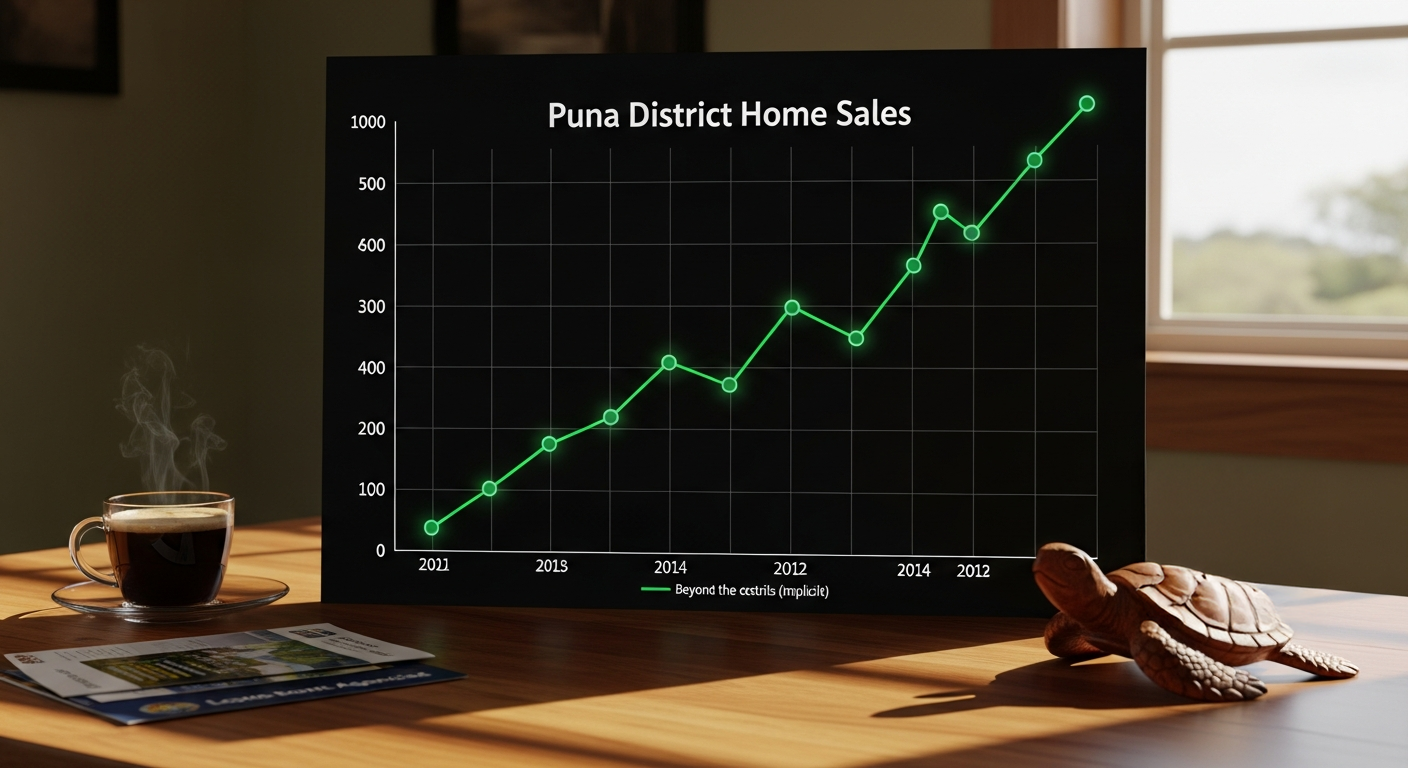
Puna (specifically Pahoa and Kea‘au) used to be the Wild West. It was cheap, off-grid, and often unpermitted. Today, it is the fastest-growing district in the entire state for the “Tech-Homesteader” demographic. We are seeing software engineers from Seattle and Austin buying 3-acre lots here, not to farm, but to code.
The Why
Three words: Fiber, Starlink, Price.
Before 2023, internet reliability here was a joke. Now, with gigabit fiber expansion and satellite redundancy, Puna has better connectivity than parts of Manoa Valley.
Couple that with the price. You can still buy a brand-new, permit-approved 3-bedroom home on an acre of land for under $500,000. In a world where the median home price in the US is creeping up, Puna remains the last bastion of the “American Dream” (affordable home ownership) within a tropical paradise.
The Insider Reality
Do not let the low price tag fool you; you pay for it in other ways. Puna is jungle.
* The Jungle Tax: Nature fights back here. Mold grows on your leather shoes overnight if you don’t have a dehumidifier. Albizia trees (massive invasive giants) can crush your roof in a windstorm. You aren’t just a homeowner; you are a land manager.
* Insurance Difficulty: This is Lava Zone 2. Securing homeowners insurance is a strategic battle. You will likely rely on the HPIA (Hawaii Property Insurance Association) plan, which is expensive and bare-bones.
* Catchment Water: Most homes are not on city water. You catch rain from your roof. It’s safe if you maintain it (filters, UV light), but if the pump breaks at 10 PM, you are the plumber.
The Data
- Median Home Price: $460,000.
- Price per Sq Ft: ~$300 (Lowest in state).
- Rainfall: 100-140 inches per year (It rains a lot).
- Insurance Cost: ~3x the national average due to lava zones.
Pros & Cons of Puna
- Pros: Incredible affordability, privacy, large lots, distinct “old Hawaii” community feel.
- Cons: Lava flows (existential risk), high insurance, constant property maintenance, distance from major hospitals (Hilo is 30-45 mins away).
Trend #3: The Flight from “Town” Condos (Honolulu)
The What
Migration is a two-way street. While people move to Ewa, they are moving out of older Honolulu neighborhoods—specifically, high-rise condos in Makiki, Waikiki, and parts of Kaka‘ako built before 1990.
The Why
The trigger is the “Condo Safety Legislation” passed in the wake of the Surfside collapse. 2026 is the year many deadline extensions expire. Buildings are now being forced to complete multi-million dollar “spalling” (concrete repair) and plumbing retrofits.
* The Assessment Bomb: Owners are getting hit with special assessments ranging from $30,000 to $80,000 per unit.
* HOA Inflation: Maintenance fees in these older buildings are crossing the $1,200/month mark.
Buyers are looking at the math: “$1,200 maintenance fee + mortgage? I could just buy a house in Kapolei.”
The Insider Reality
If you are renting, this is actually a golden era. Landlords are desperate to fill units, and you don’t pay the assessment. You can rent a renovated unit in Waikiki for a steal relative to 2022 prices.
But if you are buying? Caveat Emptor (Buyer Beware). If you see a “deal” in town—a 2-bedroom for $450k—look at the maintenance fee. Look at the meeting minutes. Is there a $10M piping project approved for next month?
The Data
- Inventory Levels: Highest in 10 years for condos >30 years old.
- Days on Market: Averaging 65+ days (extremely slow for Hawaii).
- HOA Trends: Up 18% year-over-year in older buildings.
Pros & Cons of Town Condos
- Pros: Walkable lifestyle, close to jobs/nightlife, potential for huge bargains if you have cash reserves.
- Cons: Financial uncertainty (assessments), aging infrastructure, density/noise.
Trend #4: The “Quality of Life” Move to Maui’s Upcountry
The What
Post-2023 recovery, Maui is seeing a very specific migration pattern: Locals and long-term residents are moving up. Kula, Makawao, and Pukalani are seeing a surge.
The Why
It’s about temperature. As summers get hotter, the elevation of Upcountry (1,500 – 3,000 ft) offers natural air conditioning. It is consistently 10-15 degrees cooler than Kihei or Kahului.
People are tired of running AC. They want the breeze. They want the agricultural vibe—growing their own avocados and citrus—without being totally isolated like in Hana.
The Insider Reality
The commute is the killer here. If you work in tourism (West Maui or Wailea), you are looking at a lot of driving. Also, “Country Life” means mice, centipedes, and roosters. The rooster noise in Makawao is not a joke; it is a lifestyle soundtrack you must accept.
Final Analysis: Follow the Infrastructure
When we look at where people are moving in 2026, the through-line is infrastructure.
* In Oahu, people are following the Rail.
* In Big Island, people are following the Fiber.
* In Maui, people are following the Temperature (Climate resilience).
Don’t just buy a house; buy into a trajectory. Ewa Beach is on an upswing of amenities. Older condos in town are on a downswing of maintenance debt. Pahoa is on an upswing of connectivity.
Your Move Strategy:
1. Define your tolerance for “Gritty” vs. “Polished.” (Puna vs. Kapolei).
2. Audit your commute. Do not trust Google Maps at 2 PM. Check it at 7:30 AM.
3. Check the “Hidden” Costs. (HOA fees in town vs. Insurance costs in Lava Zones).
If you need help decoding these neighborhoods, that is exactly what we do. We track these migration numbers week by week to keep you ahead of the heard. Reach out to The Agency Team here to start your plan.
Leave A Comment