
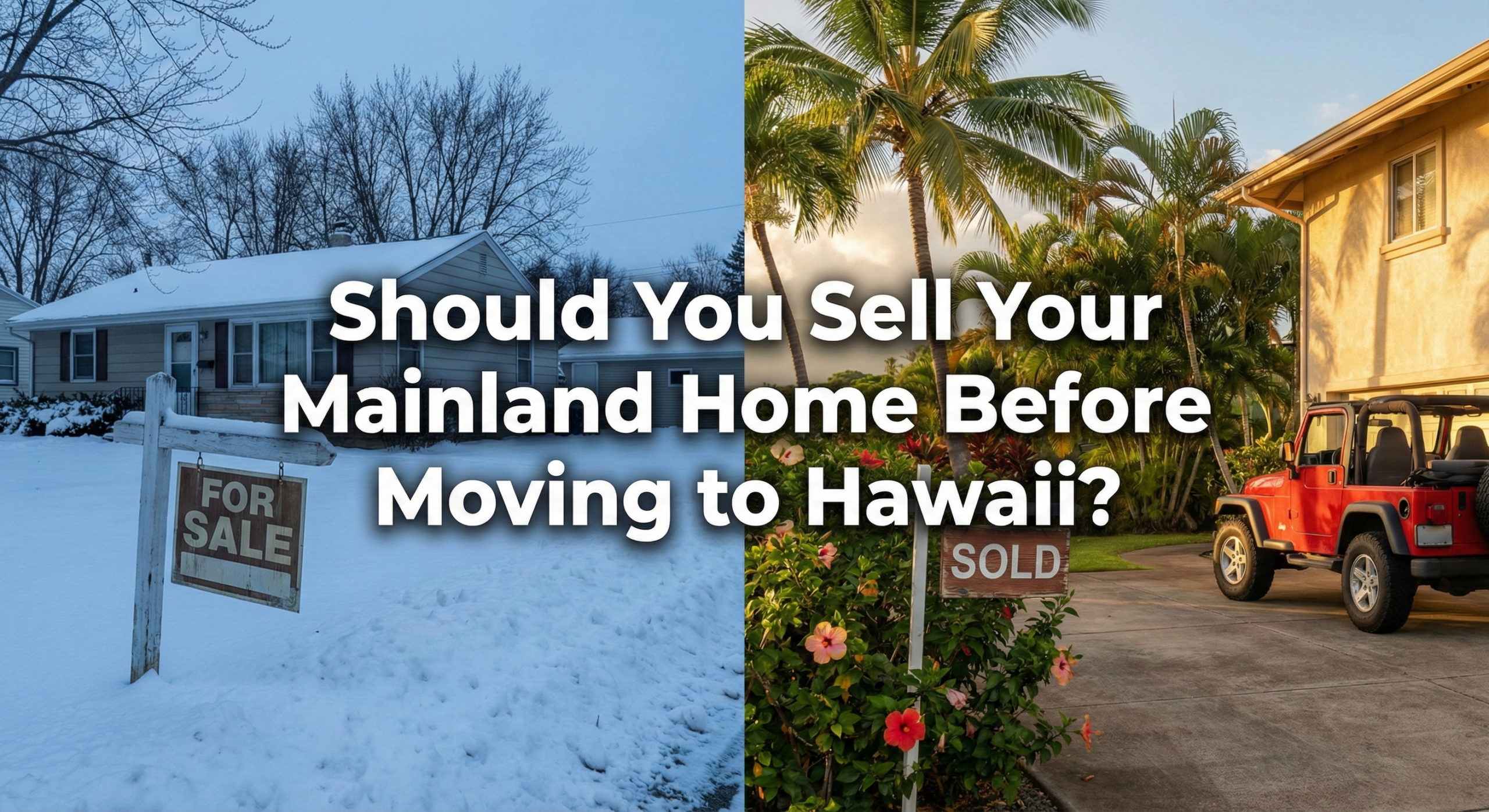
One of the most paralyzing decisions you’ll make during your PCS or relocation to Hawaii isn’t which island to pick—it’s what to do with the house you’re leaving behind.
When we moved, my spreadsheet was a mess of “what-ifs.” Do we keep the mainland house as a safety net? Do we cash out to fund the Hawaii dream? In 2026, with interest rates stabilizing but insurance premiums rising on the mainland, the calculation has changed.
I’ve seen this play out hundreds of times for new residents. Some sell and regret losing their foothold; others keep their home and drown in double mortgages. Today, we’re going to walk through the critical decision matrix to help you decide.
Quick Summary: The Decision Matrix
- Current Equity: Do you need the cash to buy in Hawaii? (Hawaii average median price is ~$1M).
- Safety Net: If Hawaii doesn’t work out, do you want a place to return to?
- Landlord Life: Are you ready to manage a rental from 2,500 miles away with a 3-6 hour time difference?
- Tax Reality: Capital Gains exemptions ($250k/$500k) have residency requirements you might lose if you rent it out too long.
Do you need the liquidity to buy in Hawaii?
This is the first and hardest question. Hawaii real estate is expensive. In 2026, the median single-family home price on Oahu hovers around the $1.1M mark. To avoid jumbo loan interest rates or mortgage insurance, you typically need a significant down payment (20% of $1M is $200,000).
If your mainland home has significant equity, selling might be the only way to comfortably afford a home here. Bringing that large cash reserve allows you to compete with cash buyers and keep your monthly mortgage payments in Hawaii manageable.

Are you mentally prepared to be a long-distance landlord?
I often tell people: “You are moving to paradise to relax, not to answer calls about a broken water heater at 3:00 AM.”
Managing a property from Hawaii is logistically difficult.
* Time Difference: When it’s 9:00 AM in California, it’s 6:00 AM or 7:00 AM here. When it’s 5:00 PM in New York, it’s the middle of our work day.
* Vendor Management: If a pipe bursts, you can’t drive over to check it. you are at the mercy of property managers or contractors.
* Cost: A good property manager costs 8-10% of monthly rent. Does your rental income cover the mortgage plus that fee plus repairs?
The “Safety Net” Psychology
Many movers keep their mainland home because they are afraid Hawaii “won’t take.” It’s a valid fear—”Island Fever” is real. Keeping the house feels like an insurance policy.
The Counter-Argument:
Keeping one foot on the mainland often prevents you from fully committing to Hawaii. When things get hard (and they will—matson shipping delays, centipedes, traffic), it’s too easy to say, “Let’s just go back.” Selling the home burns the boats. It forces you to build community, find solutions, and truly live here.
Don’t forget the Capital Gains Tax rule (Section 121)
This is the biggest financial trap. Under current IRS rules (Section 121), you can exclude up to $250,000 (single) or $500,000 (married) of capital gains from taxes if you have lived in the home for 2 of the last 5 years.
The Danger Zone:
If you move to Hawaii and rent out your mainland home for 3+ years, you may lose this exemption. If you then sell, you could owe massive taxes on your appreciation.
* Example: You bought for $400k, it’s worth $800k. If you sell now, the $400k profit is tax-free. If you rent it for 4 years and then sell, that $400k profit might be taxed at 15-20%. That’s an $80,000 mistake.

Market Coordination: Timing the Sell and Buy
If you decide to sell, timing the market is critical. You don’t want to be homeless in between. You need a team that coordinates the sell-side on the mainland with the buy-side in Hawaii.
We see many clients do a “rent-back” on their mainland home (staying in it for 30-60 days after closing) to give them time to find a place here, or they rent a short-term Airbnb in Hawaii while shopping.
If you are looking for real-time data on what your money buys in Hawaii right now, you can check the local inventory here.
Final Verdict
There is no one-size-fits-all answer, but here is my general rule of thumb for 2026:
* Sell If: You need the cash to buy here, you don’t want landlord stress, or you have massive tax-exempt gains to harvest.
* Keep If: You have a low interest rate (sub-4%), the rent covers all costs positively, and you are unsure if Hawaii is your “forever” home.
This transition is complex. For specific advice on timing your move and coordinating with realtors on both sides of the ocean, I highly recommend talking to The Agency Team—they specialize in this exact bridge.
Leave A Comment