
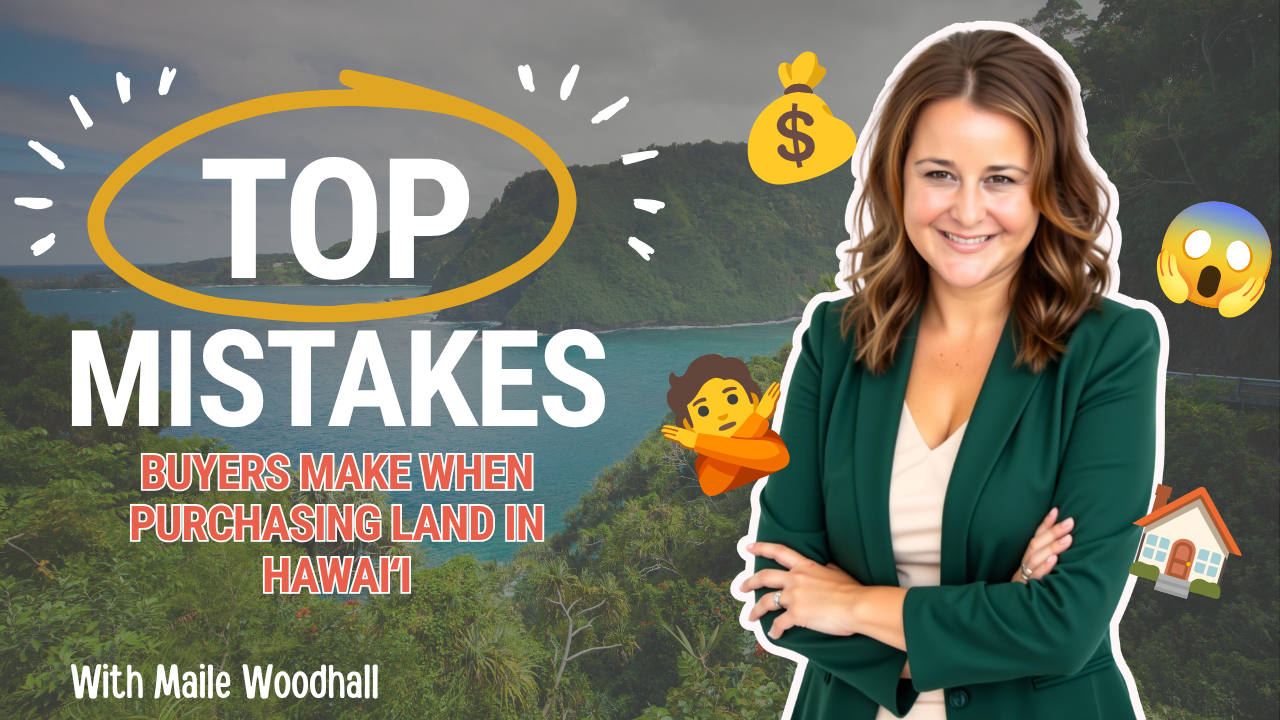
Top 8 Mistakes Buyers Make When Purchasing Land in Hawaii
Buying land in Hawai‘i is one of the most exciting things a person can do. It is also one of the easiest ways to make a very expensive mistake.
I have worked with buyers across the Big Island on everything from agricultural parcels to oceanview lots to remote acreage in the rain forest. And the same mistakes come up again and again. Not because buyers are careless. Because Hawai‘i land is genuinely different from anywhere else in the country, and the rules that apply on the mainland do not apply here.
These are the mistakes I see most often. If you are in the early stages of a land search, read this before you make an offer.
Mistake 1: Assuming You Can Build on It
This is the most common and most costly mistake I encounter.
In Hawai‘i, zoning is not just a formality. It determines what you can actually do with your land. The Big Island has several primary zoning designations, and each one carries different use rights.
Agricultural zoning covers the majority of rural land on this island. It does allow for single-family dwellings in most cases, but it also carries requirements. Some agricultural parcels require actual farming or ranching activity to maintain compliance with state land use law. On smaller ag lots, especially those under the County’s subdivision rules, what you can build and how many structures are permitted may be more restricted than buyers expect.
Conservation zoning is a different matter entirely. Land designated as Conservation by the state Land Use Commission is some of the most tightly regulated land in the country. The ability to build on Conservation land is extremely limited and requires special use permits through the Department of Land and Natural Resources. I have seen buyers fall in love with a large, dramatic parcel only to discover that Conservation zoning means they cannot put a home on it.
Rural zoning allows for residential use but with significant minimum lot sizes and restrictions on density.
Always confirm the zoning with Hawaii County Planning before you make an offer. And then understand what that zoning actually permits, not just what the seller or listing agent tells you it permits.
Mistake 2: Not Checking Water and Utilities
Hawai‘i Island is not like the mainland. County water service does not reach large portions of this island, and neither does the utility grid.
If you are purchasing land in Puna, Ka‘u, or the rural elevations of South Kona, there is a real possibility that county water service is not available. That does not make the land unbuildable. It means you will need to design and install a rainwater catchment system, which requires a properly sized tank, a metal roof, and a multi-stage filtration setup. That is an additional cost to factor into your budget before you fall in love with the price of the parcel.
The same applies to power. Large areas of the island do not have utility lines running to individual parcels. Solar with battery storage is the standard solution, and it works well. But the cost of a solar system capable of running a full household needs to be in your budget from the start, not discovered during escrow.
Road access is the third question. Some parcels on this island are legally accessible only via a private road, and that road may be unpaved, unmaintained, or shared with neighbors under an agreement that has not been updated in decades. Some parcels have what is called a paper road, which is a county-designated right-of-way that exists on maps but has never been graded or maintained and may be completely impassable.
Know your access situation before you proceed.
Mistake 3: Ignoring the Lava Zone
Every parcel on Hawai‘i Island sits within a lava zone rating, ranging from Zone 1 at the highest risk to Zone 9 at the lowest. These ratings are assigned by the U.S. Geological Survey based on historical eruption patterns and proximity to active rift zones.
This matters because insurance carriers and lenders both pay close attention to it.
Properties in Lava Zones 1 and 2 are often uninsurable through standard carriers, and some lenders will not write loans on them at all. The 2018 eruption in lower Puna, which destroyed more than 700 homes, was a real-world demonstration of what Zone 1 and Zone 2 exposure means.
That does not mean land in those zones has no value. Many buyers purchase in higher lava zones intentionally, with full awareness of the risk profile and a cash purchase that sidesteps the insurance and lending hurdles. But they are making that decision with clear eyes.
What I see go wrong is when buyers fall in love with an affordable parcel and do not discover the lava zone classification until they are trying to secure financing or homeowners coverage, at which point the deal often falls apart.
Check the lava zone early. It is one of the first things I look at.
Mistake 4: Skipping the Survey
Vacant land in Hawai‘i, particularly older agricultural parcels, can have boundary situations that are significantly more complicated than the listing description suggests.
Old subdivision plats were not always recorded accurately. Neighboring properties have occasionally been built in ways that encroach on adjacent parcels. Access easements, utility easements, and agricultural lease rights can all affect what you actually control on a given piece of land.
A current survey is not always required to close escrow on land. But skipping it is a risk that buyers sometimes regret after the fact.
Order the survey. Have a title company conduct a thorough title search. Read the preliminary title report carefully, and make sure your agent or attorney walks you through any exceptions that appear in Schedule B. Those exceptions can include easements, deed restrictions, and liens that meaningfully affect the use and value of the property.
Mistake 5: Not Understanding Road Access and Easements
This one deserves its own section because it comes up constantly.
Access to a parcel in Hawai‘i is not always straightforward. A property may be surrounded on all sides by land owned by others, with access only available via an easement across a neighboring parcel. That easement may be documented and legally sound, or it may be informal and difficult to enforce.
Private roads are common in rural subdivisions across the island. These roads are not maintained by the county. The responsibility for upkeep falls on the property owners who use them, sometimes organized through a road maintenance association and sometimes handled on an informal neighbor-to-neighbor basis.
Before you close on any land parcel, know exactly how you get to it, who owns the road, who is responsible for maintaining it, and what happens if that maintenance breaks down.
Mistake 6: Confusing Fee Simple and Leasehold
In most of the United States, when you buy real property you buy it outright. In Hawai‘i, that is not always the case.
Leasehold properties are those where you purchase the right to use and occupy the land for a defined period, but the underlying land itself is owned by someone else, typically a large trust or estate. When the lease expires, the land reverts to the underlying owner.
Leaseholds are more common in residential real estate than in raw land, but they exist in the land market too. Buyers from the mainland sometimes miss this distinction entirely until they are reviewing the purchase contract.
Know whether you are buying fee simple ownership of the land or a leasehold interest. If it is leasehold, understand when the lease expires, what the renegotiation terms look like, and how that affects your ability to finance and eventually resell the property.
Mistake 7: Underestimating What It Costs to Build
Raw land is often priced attractively. The cost of what comes next is where buyers get surprised.
Construction costs on the Big Island are among the highest in the country. Materials must be shipped to the island. Contractor availability is constrained. Permitting through Hawaii County can take longer than buyers anticipate, sometimes significantly longer for properties that require special permits due to zoning, slope, or environmental review.
A basic single-family home on a rural parcel can easily cost $400 to $600 per square foot or more to build, depending on design, access, and site conditions. That number does not include well or catchment system installation, solar, septic, or road improvements.
Before you commit to a land purchase, build out a realistic cost-to-develop scenario. Talk to a local contractor who has built in the area. Understand what permits are required and what the typical timeline looks like. The parcel price is just the beginning.
Mistake 8: Working Without Local Expertise
Hawai‘i land has its own rules, its own culture, and its own due diligence requirements. An agent who primarily works residential sales may not be fluent in the specific questions that matter for agricultural parcels, Conservation land, or large acreage.
The same applies to attorneys and contractors. Local knowledge matters here in ways that are hard to overstate.
I have guided buyers through land transactions where understanding the county’s agricultural subdivision rules, the state’s conservation district regulations, and the specific lava zone and catchment infrastructure requirements all in one conversation was the difference between a sound purchase and a very costly mistake.
If you are serious about land on the Big Island, work with someone who lives and breathes it. Ask hard questions. Get specific answers. And take the time to understand what you are actually buying before you commit.
Land in Hawai‘i can be one of the most rewarding investments you ever make. The island’s landscape, its climate, and the way of life it supports are genuinely singular. But the path to a smart land purchase here runs through due diligence that most buyers are not expecting.
If you have questions about a specific parcel, a zoning situation, or what it actually takes to develop land on the Big Island, I would be glad to talk through it with you.
Leave A Comment