
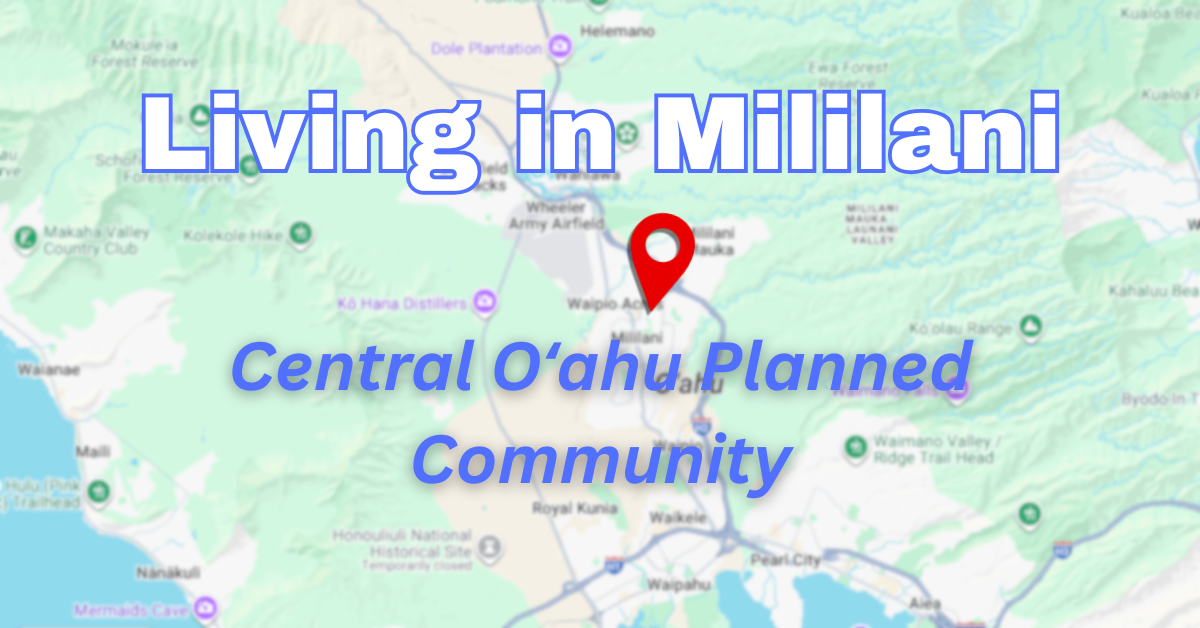
Living in Mililani: Central Oʻahu Planned Community
When people talk about Mililani, they’re usually talking about two distinct neighborhoods that share a name and a zip code but have their own vibe. Understanding the difference between Mililani Town and Mililani Mauka matters if you’re considering a move here, and the short version is this: they’re separated by H-2, built about 25 years apart, and each has trade-offs worth knowing about.
The central location is what draws most people in. You’re roughly equidistant from everything that matters on this island—downtown Honolulu, the North Shore, Pearl Harbor, and Schofield Barracks all fall within that 20-30 minute range when traffic cooperates. For military families stationed at Schofield, the commute is legitimately easy, often 5-10 minutes depending on which gate you use.
Mililani Town: The Original Side
Mililani Town is the west side of H-2, the original development that started in the late 1960s when Castle & Cooke turned pineapple fields into suburban housing. The homes here tend to be older, but that also means bigger lots and more single-level floor plans. If yard space matters to you, Town usually delivers more of it for less money compared to Mauka.
This is also where almost all the shopping and commercial activity lives. You’ve got three main hubs—Mililani Shopping Center, Mililani Town Center, and the Gateway at Mililani Mauka—but the bulk of what you need day-to-day is on the Town side. Walmart, Safeway, Foodland, Times Supermarket, Longs Drugs, restaurants, a movie theater with the reclining seats, and even a gym. It’s about as close to a mainland suburb as you’ll find on Oahu, which is either a selling point or a drawback depending on what you’re looking for.
Mililani Mauka: Newer, Tighter, Pricier
Mauka, which means mountain side in Hawaiian, sits east of H-2 and started development in the early 1990s. Homes here are newer, which usually translates to modern finishes and updated construction, but the trade-off is smaller lot sizes. You’re paying a premium for that newness—expect to spend more per square foot compared to Town.
The other thing about Mauka is the access. There’s essentially one main road in and out, Meheula Parkway, and during morning and evening rush, that can create a bottleneck. It’s not gridlock, but if you’re commuting during peak hours, you’ll notice it. Some residents swear the elevation makes it slightly cooler and greener up here, and honestly, the landscaping does tend to look lusher.
Both Town and Mauka feed into the same school system, so that’s not a differentiator. If you’re trying to figure out which side fits your budget and lifestyle better, browsing current Mililani listings gives you a real-time sense of what’s available and where the price points actually land.
Schools That Actually Deliver
This is one of Mililani’s biggest draws. The public schools here are consistently ranked among the best on Oahu, and that reputation isn’t just marketing. Mililani High School is ranked number one among public high schools in Hawaii and sits in the top 30% nationally. The school has a solid AP program, a 94% graduation rate, and strong college readiness scores.
Elementary schools like Mililani Mauka Elementary and Mililani Waena Elementary pull good reviews from parents, and Mililani Middle School serves as the feeder into the high school. If you’re moving with kids and want a strong public school system without paying private school tuition, this is one of the few places on Oahu where that’s genuinely possible.
Recreation and the MTA Fee
Mililani has seven recreation centers with pools, and you’ll see people using them. The community also has parks throughout, sidewalks on every street, and the Mililani Golf Club if you’re into that. One thing to know upfront: every homeowner in Mililani pays quarterly fees to the Mililani Town Association. This covers maintenance of common areas, the rec centers, and enforcement of community standards.
Some people see it as an annoyance, but it’s also why property values stay relatively stable here and why the neighborhood doesn’t look run-down. The MTA keeps things consistent, which matters if you’re buying rather than renting.
Commute Realities: H-2 Access Is Key
Mililani sits right off H-2, which is both a blessing and a complication. If you’re heading north to Schofield, Wahiawa, or the North Shore, you’re golden. If you work downtown or at Pearl Harbor, you’re merging onto H-1 during the exact same time as everyone else coming from Kapolei and Ewa Beach, and that H-1/H-2 merge is one of the island’s worst choke points.
A 12-mile commute to downtown can take 45-60 minutes during morning rush. If you’re willing to leave before 5:30 a.m., you can beat most of it. If not, you’re sitting in traffic with everyone else. This is the single biggest trade-off of living in Mililani—you get affordability, good schools, and a suburban feel, but you pay for it in commute time if you work on the south side of the island.
Weather and Climate
Mililani sits at a slightly higher elevation than Honolulu, which means it’s a few degrees cooler year-round. You’re looking at temps in the 70-85°F range most of the time, and yes, it rains more here than in town, but less than the windward side. The rain keeps everything green, which is part of why the area looks so maintained.
Who Mililani Works For
This community makes sense for families who prioritize schools and safety, military personnel at Schofield who want an easy commute and a real neighborhood feel, and anyone who values suburban amenities over beach proximity. If you’re looking for walkable urban living or quick access to the ocean, Mililani probably isn’t your spot. But if you want a functional, family-oriented place with solid infrastructure and a sense of community, it’s one of the better options on Oahu.
The price tags reflect that demand. Homes in Mililani Town typically start in the mid-$900,000s and can push past $1.5 million depending on condition and location. Mauka tends to run even higher. It’s not cheap, but compared to Hawaii Kai, Kailua, or Kaneohe, you’re getting more house and better schools for the money. For a deeper look at market trends, neighborhood insights, and what’s currently on the market, check out our complete Mililani real estate guide.
Frequently Asked Questions
What’s the difference between Mililani Town and Mililani Mauka? Mililani Town is the original development west of H-2, with older homes on bigger lots and all the shopping. Mililani Mauka is newer, east of H-2, with smaller lots and newer construction. Both share the same school system and rec centers.
How long is the commute from Mililani to downtown Honolulu? Plan on 45-60 minutes during morning rush hour. If you leave before 5:30 a.m., you can cut that significantly. The H-1/H-2 merge is the main bottleneck.
Are the schools in Mililani really that good? Yes. Mililani High School is ranked first in Hawaii for public high schools, and the elementary and middle schools consistently score well. It’s one of the main reasons families move here.
What’s the Mililani Town Association fee, and what does it cover? All homeowners pay quarterly fees to the MTA (amounts vary by property). This covers maintenance of parks, rec centers, pools, and enforcement of community standards. It’s mandatory and unavoidable.
Is Mililani a good area for military families stationed at Schofield Barracks? Absolutely. The commute to Schofield is 5-10 minutes, the schools are strong, and the community is family-friendly with lots of other military families. It’s one of the top picks for Schofield personnel living off-base.


Leave A Comment