
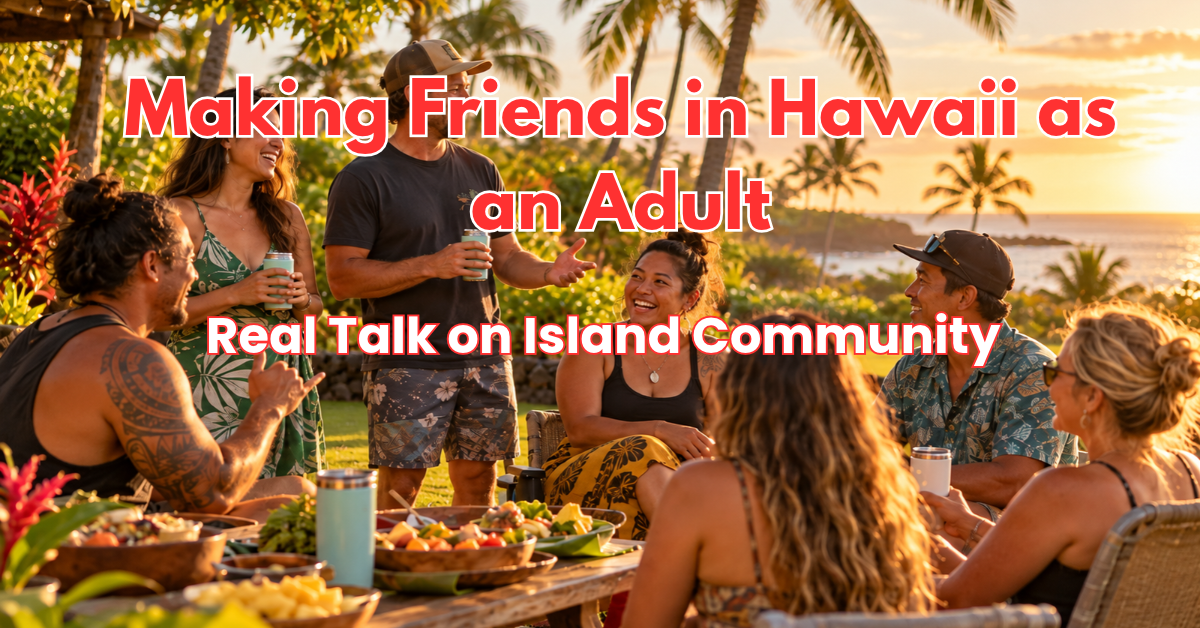
Making Friends in Hawaii as an Adult: Real Talk on Island Community
Moving across an ocean to build a life in Hawaii comes with an undeniable romantic pull. You imagine quiet sunset surf sessions, casual backyard barbecues, and a warm neighborhood circle that welcomes you with open arms. Then reality settles in around month three. You unpack the shipping container, establish a work rhythm, and suddenly notice that your social calendar is completely empty. Making friends as an adult is notoriously challenging anywhere in the world, but in Hawaii, the geographic isolation and unique social fabric add layers that catch many newcomers off guard.
Take the Quiz: Is Hawaii Right For You? Meet with a Living in Hawaii Expert!
We hear this story constantly from recent arrivals. People move here expecting immediate warmth because the islands are world-famous for hospitality, yet they find themselves struggling to move past superficial pleasantries at the grocery store or gym. Developing real, lasting friendships in Hawaii is entirely possible, but it requires patience, emotional self-awareness, and a genuine respect for how island communities function. Let us talk story about what it actually takes to build your circle here from the ground up.
The Two-Year Rule: Understanding Island Transient Fatigue
Before you can successfully make connections in Hawaii, you must understand the psychological defense mechanism shared by many longtime residents. It is colloquially known as the two-year rule. Hawaii experiences an exceptionally high rate of population turnover. Thousands of people move to the islands every single year, enchanted by the landscape, only to leave twenty-four months later when confronted by astronomical housing costs, distance from mainland family, medical specialist shortages, or persistent homesickness.
Because of this constant churn, established locals and long-term transplants naturally protect their emotional energy. Investing time, vulnerability, and hospitality into someone who may pack up and return to California or Colorado next summer feels exhausting. When you first arrive, people are not necessarily rejecting you as an individual. Rather, they are reserving their deeper social energy until they see whether you are truly committed to staying and contributing to the community.
Passing this unspoken threshold requires consistency. When you show up to the same paddle club, volunteer restoration group, or coffee shop week after week without demanding instant best-friend status, people notice. Overcoming transient fatigue is not about proving your worth through loud declarations of how much you love the islands. It is about quietly showing that your roots are digging in for the long haul.
Why Adult Friendships Feel Harder in the Islands
Adult connection feels elusive in Hawaii for several practical and structural reasons. Acknowledging these hurdles helps normalize the experience so you do not internalize early loneliness as personal failure.
The Economic Grind and Busy Calendars
Hawaii consistently ranks among the most expensive states in the country. To thrive here, many residents work multiple jobs, manage busy multi-generational households, or juggle intense side hustles. Free time is a precious, carefully guarded resource. Unlike some mainland cities where happy-hour culture dominates weekdays from 5:00 PM to 8:00 PM, island life often revolves around early mornings, school athletics, family obligations, and winding down shortly after sunset. Spontaneous social invitations can be rare simply because people are working hard to afford their lives.
Tight-Knit Intergenerational Networks
In many mainland metropolitan areas, a significant percentage of residents moved there from somewhere else, creating an environment where everyone is actively seeking friends. In Hawaii, a substantial portion of the population was born and raised here, attending local schools and growing up within deeply rooted extended families. Their social calendars are already completely full with cousin birthdays, baby showers, sports leagues, and church gatherings. They simply do not have the social void that a newcomer brings with them off the plane.
Neighborhood Density and Walkability
Depending on which island and neighborhood you settle into, casual social encounters can be limited. While a few specific areas foster organic pedestrian mingling, many residential valleys and suburban subdivisions are car-dependent. When evaluating the best walkable towns in Hawaii, you quickly realize how much physical environment impacts social frequency. If you drive into an enclosed garage and shut the door every evening, your chances of running into neighbors drop to near zero.
The Etiquette of Connection: Culture, Humility, and Listening
Building genuine relationships in Hawaii requires a distinct social etiquette that contrasts sharply with fast-paced mainland networking. If you treat making friends as an exercise in networking or personal branding, you will quickly hit a wall of polite silence.
Talk Story Instead of Interviewing
Mainland social interactions often begin with aggressive occupational vetting: “What do you do for work? Where did you go to school? Where do you live?” In Hawaii, this line of questioning can come across as transactional, pretentious, or nosy. Island culture prioritizes authentic connection over resume swapping.
Instead, embrace the tradition of talking story. Let conversations wander naturally. Comment on the ocean conditions, the weather, what you cooked for dinner, or a shared observation about the neighborhood. Listen far more than you speak. Showing genuine curiosity about another person without trying to evaluate their professional status signals humility and kindness, two virtues that go exceptionally far in island society.
Check Mainland Arrogance at the Gate
Nothing alienates potential friends faster than comparing Hawaii unfavorably to wherever you moved from. Complaining about the lack of specific mainland restaurant chains, slower shipping speeds, bureaucratic delays, or municipal infrastructure signals that you expect Hawaii to change for you, rather than adapting yourself to Hawaii. Approach your new home with curiosity, gratitude, and an appetite to learn how things have worked here for generations.
The Power of Small Offerings
Island culture places deep value on reciprocity and sharing abundance. Never show up completely empty-handed to someone’s home, patio, or tailgate. You do not need to spend large amounts of money. Bringing a bag of fresh fruit from your yard, a box of pastries from a local bakery, or extra cold drinks to share demonstrates respect and awareness. It indicates that you understand relationships are built on mutual care rather than selfish convenience.
Proven Pathways to Finding Your Ohana
Sitting in your living room hoping for serendipity will leave you isolated. To build a thriving circle, you must place yourself in recurring environments where shared effort creates natural camaraderie. Our detailed guide on building community fast after moving to Hawaii outlines key structural steps, but let us look closely at the specific avenues where friendships blossom most naturally.
1. Outdoor Stewardship and Malama Aina
One of the healthiest ways to integrate into island life is through physical volunteer service, often referred to as malama aina, which means caring for the land. Non-profit watershed projects, fishpond restorations, trail maintenance crews, and taro patch workdays bring together diverse groups of people united by common purpose.
When you stand knee-deep in mud pulling invasive weeds or hauling volcanic rock alongside someone for four hours, artificial social barriers vanish. You work together, share a communal lunch of stew and rice, and bond over tangible labor. These environments attract grounded, community-minded individuals who make outstanding friends.
2. Ocean Sports and Athletic Clubs
The ocean is the beating heart of recreation in Hawaii, and ocean-based sports are inherently communal. Joining an outrigger canoe paddling club is widely considered one of the single best avenues for making friends of all ages. Novice paddling programs welcome adults who have never held a paddle before, teaching safety, technique, and teamwork.
In an outrigger crew, six individuals must synchronize their strokes perfectly to move the boat efficiently through ocean swells. That level of cooperation builds fast trust and deep camaraderie. Beyond paddling, adult soccer leagues, masters swimming groups, Brazilian jiu-jitsu academies, running clubs, and beach volleyball groups offer recurring weekly contact with active peers.
3. Skill-Based Workshops and Local Craft Classes
If athletic endeavors are not your preference, explore recurring educational spaces. Look for community classes in Hawaiian language, botanical gardening, ceramics, woodworking, or native lei making. Adult education classes hosted by community colleges, botanical gardens, and arts centers provide structured social interaction centered around learning. Because attendees share an appreciation for creativity or cultural understanding, conversation flows far more comfortably than at a noisy bar.
4. Neighborhood Presence and Routine
Routine is the great equalizer of social life. Find your neighborhood coffee shop, farmers market stall, community dog park, or beach park, and visit at the exact same times every week. Wave to the crossing guard. Buy your produce from the same farmer. Say good morning to the morning dog walkers. Over months, familiar faces turn into casual acquaintances, and casual acquaintances gradually turn into front-porch conversations.
Pros and Cons of Different Social Avenues in Hawaii
Every pathway to friendship has its unique advantages and drawbacks. Selecting the right focus helps you invest your social energy where it yields the healthiest results.
Outrigger Canoe Clubs and Sports Leagues
-
Pros: Excellent physical fitness, deep team bonding, highly structured schedules, diverse mix of long-term locals and transplants.
-
Cons: High time commitment with mandatory practices, early weekend mornings, seasonal schedules that pause during the winter months.
Environmental and Cultural Volunteering
-
Pros: Fosters genuine cultural humility, deeply rewarding physical work, introduces you to community elders and stewards, low barrier to entry.
-
Cons: Often physically demanding, usually takes place on Saturday mornings, requires reliable transportation to rural valleys or coastlines.
Digital Groups and Transplant Meetups
-
Pros: Immediate access to people who are also actively seeking friends, low intimidation factor, shared initial relocation experiences.
-
Cons: High vulnerability to transient turnover, can occasionally devolve into complaint sessions about island life, lacks organic local integration.
Navigating the Transplant-versus-Local Balance
One common dilemma newcomers face is whether to seek friendship predominantly among fellow transplants or among long-term locals. The reality is that a balanced, fulfilling life in Hawaii includes both circles, each fulfilling different emotional needs.
Transplant friends are essential during your first year. They understand the specific sting of missing mainland holidays, the disorientation of navigating Hawaii health insurance or shipping systems, and the shared excitement of exploring new hiking trails. You can talk openly with them about mainland transitions without burdening local friends with repetitive questions about basic island logistics.
At the same time, limiting yourself exclusively to a transplant bubble isolates you from the authentic soul of Hawaii. When you only spend time with other recent arrivals, your entire social circle remains precarious. If two couples in your group suddenly decide to move back to the mainland, your social world can collapse overnight. Cultivating relationships with multigenerational residents roots you in the history, humor, values, and community responsibilities of your home island. When considering which Hawaiian island fits your long-term goals, factor in the community structure of each island, as rural neighbor islands often require even deeper reliance on local community networks than urban Oahu.
Real Talk on Introversion and Loneliness
If you are naturally introverted, moving to Hawaii can feel doubly isolating. The pressure to be outdoors constantly, paired with the social energy needed to break into established groups, can trigger retreat. It is completely normal to experience periods of intense loneliness during your first eighteen months on island. Nearly every person who has successfully built a lasting life here will admit, if they are honest, that they spent several weekend nights during year one wondering if they made a colossal mistake.
Give yourself grace during this window. Building an authentic village from scratch takes time. Do not measure your success by the size of your group chat or whether you have plans every Friday night. Aim for quality over volume. One reliable friend you can text when you need someone to split a Costco run or watch your dog during an emergency is worth twenty superficial acquaintances.
Stay patient, show up consistently, offer help whenever you see an opportunity, and treat everyone you encounter with warmth and patience. Community in Hawaii is not something you purchase or demand. It is something you earn through steady presence, kindness, and time.
Leave A Comment