
Living in Kailua-Kona, Big Island: What It’s Actually Like in 2026
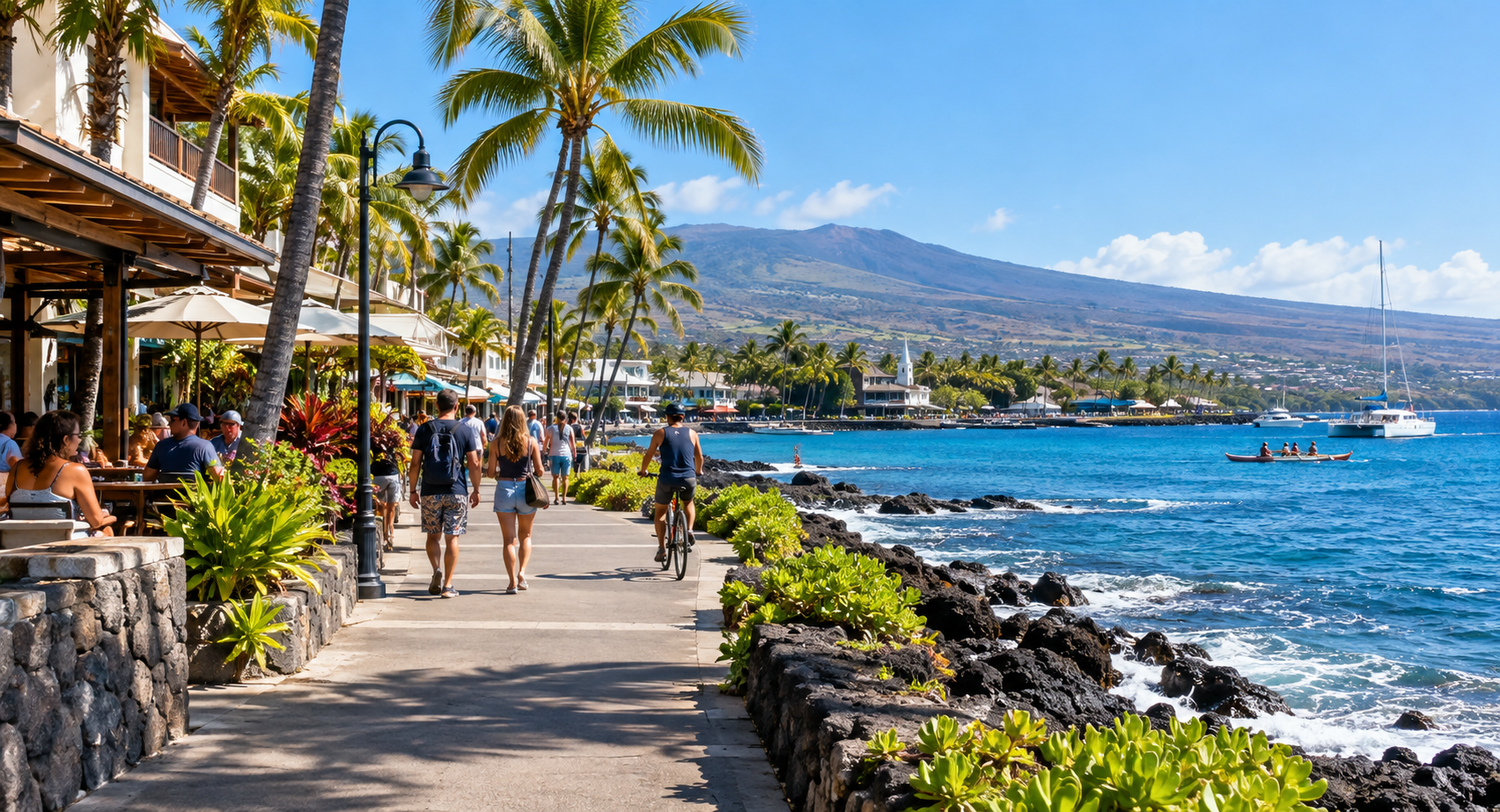
When people think about moving to Hawaii, the image in their mind often mirrors Kailua-Kona: black lava fields meeting deep turquoise water, palm trees swaying along coastal streets, and warm sunshine year-round. Kailua-Kona serves as the economic and cultural center of West Hawaii, offering an energetic coastal rhythm that contrasts sharply with the lush, sleepy ambiance of Hilo on the east side. But moving here is entirely different from spending seven days at an oceanfront resort. In 2026, living in Kailua-Kona, Big Island means navigating unique infrastructure challenges, dramatic microclimates, and a shifting housing market, all while enjoying some of the most spectacular natural beauty on earth.
Take the Quiz: Is Hawaii Right For You? Meet with a Living in Hawaii Expert!
The Elevation Game: Kona Microclimates and Geography
One of the first lessons newcomers learn about Kailua-Kona is that your elevation dictates your lifestyle. The district stretches from sea level along Kailua Bay up the steep western slopes of Hualalai volcano. In Hawaii, we describe directions using two essential terms: makai (toward the ocean) and mauka (toward the mountain). In Kona, deciding whether you live makai or mauka changes everything from your monthly electricity bill to how often you use a blanket at night.
At sea level along Alii Drive or in the town core, temperatures consistently hover in the mid-80s to low-90s Fahrenheit. The sunshine is intense, the trade winds are frequently blocked by the sheer mass of Mauna Loa and Hualalai, and air conditioning becomes a major expense unless your home catches reliable onshore afternoon breezes. If you prefer hot beach weather, vibrant ocean access, and walking to restaurants, living makai delivers that daily reality.
Move just ten minutes uphill into upper Kona or the artistic village of Holualoa at elevations between 1,000 and 2,000 feet, and the environment transforms. Temperatures drop roughly three to four degrees for every 1,000 feet of elevation gain. Mauka neighborhoods experience afternoon cloud cover, gentle rains, and crisp evening breezes that eliminate the need for air conditioning entirely. This fertile belt is where world-famous Kona coffee thrives. However, mauka living also brings higher humidity, occasional mold management, and regular rainfall that can leave your yard perpetually damp during winter months.
Air quality is another geographic factor to consider. When Kilauea or Mauna Loa erupts, volcanic smog, known locally as vog, drifts around the southern edge of the island and collects along the Kona coast due to prevailing wind patterns. While 2026 has seen manageable air quality levels, anyone with chronic respiratory conditions should monitor vog patterns carefully. For more background on how volcanic activity impacts daily life and property values, review our guide to living near volcano zones and understanding lava hazards.
The 2026 Housing and Real Estate Reality in Kona
Housing in Kailua-Kona continues to command high values, driven by persistent demand from Mainland relocators, remote workers, and second-home owners. In 2026, the median sales price for a single-family home in the Kailua-Kona district hovers near $1.15 million, while condominium medians sit around $620,000. Inventory remains tight, and competition for turnkey properties under $900,000 is fierce.
Condominium living is popular along Alii Drive, but buyers must examine homeowners association fees closely. Across Hawaii, commercial property and hurricane insurance premiums have increased dramatically over the past three years. In many Kona complexes, monthly HOA dues now range from $700 to well over $1,400 per month, covering master insurance policies, exterior maintenance, landscaping, and pool amenities. These recurring costs can significantly adjust your purchasing power.
For renters, the market requires preparation and speed. Long-term rental housing is in high demand, particularly because many property owners historically favored short-term vacation rentals. A typical two-bedroom rental apartment in Kailua-Kona in 2026 commands between $2,800 and $3,800 per month, rarely including utilities. If you are preparing to rent before buying, our detailed walkthrough on finding long-term rentals in Hawaii covers documentation requirements, pet policies, and deposit expectations.
Prospective homeowners must also pay attention to wastewater systems. Much of Kailua-Kona, outside the municipal core, relies on private cesspools or septic tanks. Hawaii Act 125 mandates the conversion of all cesspools by 2050. When evaluating older single-family properties in neighborhoods like Kona Palisades or Kealakekua, factor in potential replacement costs, which often exceed $30,000 to $50,000 depending on rocky ground conditions.
Daily Infrastructure: Traffic, Groceries, and Car Dependency
Life in Kailua-Kona feels like a bustling small town with big-island logistical realities. West Hawaii was not originally built to handle the population density it accommodates today, which creates distinct daily commuting bottlenecks.
The primary artery through town is Queen Kaahumanu Highway, running north toward the Ellison Onizuka Kona International Airport and the Kohala Coast resort corridor. Morning commute traffic flowing north toward hotel properties combines with school traffic along Kuakini Highway and Palani Road to create slow crawls between 6:45 AM and 8:30 AM. A secondary rush occurs between 3:30 PM and 5:30 PM. While Kona traffic is nowhere near the scale of Honolulu’s H-1 freeway, sitting in bumper-to-bumper heat on a two-lane stretch of road tests the patience of any newcomer.
Public transit options are minimal. The county-run Hele-On Bus operates island-wide routes, but schedules are spaced far apart and routes cater primarily to commuter shifts rather than spontaneous neighborhood errands. Having a dedicated vehicle is essential for daily living. You can explore full operational costs in our resource on navigating transportation and car ownership on the Big Island.
When it comes to running errands, Kona acts as the retail lifeline for the entire western side of the island. Kailua-Kona hosts the island’s only Costco, located in the Kaloko Light Industrial Area. A Costco membership is practically mandatory for residents aiming to manage grocery budgets. Major retailers including Target, Walmart, Home Depot, Lowe’s, and Safeway also operate here. For local produce, fresh fish, and community connection, residents rely on KTA Super Stores and popular farmers markets like the Kona Farmers Market in town and the Sunday market in Keauhou.
Cost of Living: The Monthly Kona Budget Breakdown
Living in Kona demands financial intentionality. Beyond high housing costs, everyday utilities and consumer goods carry a visible ocean-freight markup. Everything shipped across the Pacific arrives with added transport expense.
Electricity is often the biggest shock for new transplants. Hawaiian Electric (HELCO on Hawaii Island) rates are among the highest in the United States, frequently exceeding $0.42 to $0.48 per kilowatt-hour in 2026. A modest single-family home running central air conditioning or several window units can easily rack up electric bills between $450 and $750 per month. Consequently, homes equipped with owned photovoltaic solar systems and battery storage command significant resale premiums and save owners thousands of dollars each year.
Water service through the Hawaii County Department of Water Supply is dependable, but rates reflect the energy needed to pump water across varied volcanic terrain. High-elevation homes requiring private catchment water tanks face different considerations, including filter maintenance, UV sterilization, and seasonal rainfall monitoring.
Dining out along Alii Drive or at local cafes reflects resort-adjacent pricing. Casual lunches for two often reach $45 to $60, while sit-down dinners with cocktails regularly exceed $130. To live sustainably in Kona, learning to cook at home using local ingredients, purchasing bulk staples, and adopting a simpler culinary routine becomes second nature.
Healthcare and Medical Realities in West Hawaii
Healthcare availability is one of the most critical topics we discuss with anyone planning a move to the Big Island. While Kailua-Kona has medical clinics, urgent care centers, and private family practices, specialized healthcare resources remain limited.
The primary acute-care facility on the west side is Kona Community Hospital, located south of town in Kealakekua. The hospital provides emergency services, imaging, surgery, and inpatient care. However, specialized medicine, including complex pediatric care, advanced oncology, neurosurgery, and certain cardiology procedures, frequently requires travel to Queen’s Medical Center or Straub Medical Center in Honolulu on Oahu.
Securing a primary care physician in Kona often takes several months because many practices maintain waitlists for new patients. If you or a family member manage a chronic health condition that requires frequent specialist visits, you must research provider networks and direct flight availability to Oahu before committing to a relocation in West Hawaii.
Kona Neighborhood Breakdown: Where Do People Actually Live?
Kailua-Kona is not a single uniform community. It is composed of diverse pockets, each offering distinct microclimates, housing styles, and price points.
1. Kailua Village and the Alii Drive Corridor
Alii Drive is the historic heart of Kona, stretching south from the pier past beaches, condo complexes, and oceanfront homes. Living here means you can walk to coffee shops, watch outrigger canoes launch at Kailua Bay, and enjoy direct ocean breezes. Housing consists heavily of low-rise condominiums built between the 1970s and 1990s, alongside multi-million-dollar oceanfront estates.
-
Pros: Unmatched ocean access, high walkability, incredible sunset views, active community atmosphere.
-
Cons: Tourist foot traffic, high humidity, higher insurance and HOA fees, road closures during major sporting events like the Ironman World Championship.
2. Kona Palisades and Upper Kaloko
Perched north of town above Queen Kaahumanu Highway, Kona Palisades provides suburban living on terraced hillside streets. Elevations range from 500 to 1,500 feet, offering sweeping coastal views and noticeably cooler evenings than downtown. Homes here are primarily single-family properties built from the 1980s onward on quarter-acre to half-acre lots.
-
Pros: Expansive ocean panoramas, cooler elevation, close proximity to the airport and Costco, quiet residential streets.
-
Cons: Car-dependent for every errand, steep driveways, older cesspools requiring eventual conversion, limited sidewalk infrastructure.
3. Keauhou and Kahaluu
Located at the southern end of Alii Drive, Keauhou is a master-planned community centered around Keauhou Bay, the Kona Country Club golf course, and the Keauhou Shopping Center. Kahaluu Beach Park, famous for beginner surfing and snorkeling with green sea turtles, sits just north. Real estate ranges from golf-course townhomes to gated luxury communities.
-
Pros: Well-maintained infrastructure, nearby grocery and dining options, protected ocean bay for paddling, manicured neighborhoods.
-
Cons: Strong HOA guidelines, higher purchase prices, distance from the industrial center and airport.
4. Holualoa and Mauka Kona
Holualoa sits along the scenic Mamalahoa Highway at an elevation of 1,400 feet. This historic village is filled with art galleries, historic coffee farms, and lush tropical foliage. Living in Holualoa feels pastoral, private, and distinctly artistic, appealing to those who favor cooler mountain air over immediate beach proximity.
-
Pros: Moderate year-round temperatures, lush garden settings, rich artistic culture, large agricultural lots.
-
Cons: Frequent afternoon rain, narrow winding roadways, high humidity indoors, 15 to 20-minute drive down the mountain for basic retail needs.
Community, Culture, and Social Connection
Moving to Kailua-Kona successfully requires an understanding of island pace and respectful community integration. Kona is not a place that responds well to Mainland urgency or aggressive networking. Building genuine relationships takes time, humbleness, and active participation in community life.
The ocean is the social living room of Kailua-Kona. Joining an outrigger canoe club at Kailua Pier, swimming at Kamakahonu Bay (King Kam beach), surfing at Pine Trees or Kahaluu, and attending local beach cleanups are the primary ways residents connect. When you show up consistently, lend a hand, and listen more than you speak, the community welcomes you with warm generosity.
It is equally essential to respect Native Hawaiian culture and historical landmarks. Kailua-Kona was the royal seat of King Kamehameha I, who spent his final years at Kamakahonu. Heiau (ancient temples), petroglyph fields, and burial grounds exist throughout the region. Treating these sacred spaces with reverence is fundamental to life here.
The Honest Pros and Cons of Living in Kailua-Kona in 2026
To help you evaluate whether Kailua-Kona matches your long-term goals, here is an unvarnished look at the advantages and trade-offs of daily life in West Hawaii:
Pros of Living in Kailua-Kona
-
Consistent Warm Weather: Kona enjoys reliable sunshine, making outdoor recreation accessible 365 days a year.
-
World-Class Ocean Recreation: Diving, snorkeling, spearfishing, and outrigger paddling right at your doorstep.
-
Direct Mainland Access: Kona International Airport offers direct nonstop flights to major West Coast hubs, simplifying trips to visit Mainland family.
-
Commercial Convenience: Access to essential big-box retailers like Costco, Home Depot, and Target within a 15-minute radius.
-
Tight-Knit Community: A strong community fabric centered around ocean sports, farming, and local arts.
Cons of Living in Kailua-Kona
-
High Cost of Housing and Energy: Real estate prices and HELCO utility bills remain among the highest in the country.
-
Traffic Bottlenecks: Limited arterial roadways create recurring delays along Kuakini and Queen Kaahumanu highways.
-
Healthcare Capacity Limits: Serious or specialized medical treatments frequently require an inter-island flight to Oahu.
-
Intense Makai Heat: Sea-level neighborhoods can feel uncomfortably hot without steady breezes or high-cost air conditioning.
-
Isolation from Other Towns: Driving to Hilo takes roughly an hour and a half across Saddle Road, and public transit is minimal.
Is Kailua-Kona Right for You?
Living in Kailua-Kona, Big Island is an intentional choice. It rewards people who prioritize outdoor living, community connection, and natural rhythms over consumer convenience and urban nightlife. If you need extensive public transit, four distinct seasons, or specialized medical facilities within a short drive, Kona may present difficult compromises. But if you come prepared for the financial realities, respect the culture and local pace, and embrace the simple joy of ocean breezes after a hard day’s work, Kailua-Kona can become a deeply fulfilling place to call home in 2026.
Leave A Comment