

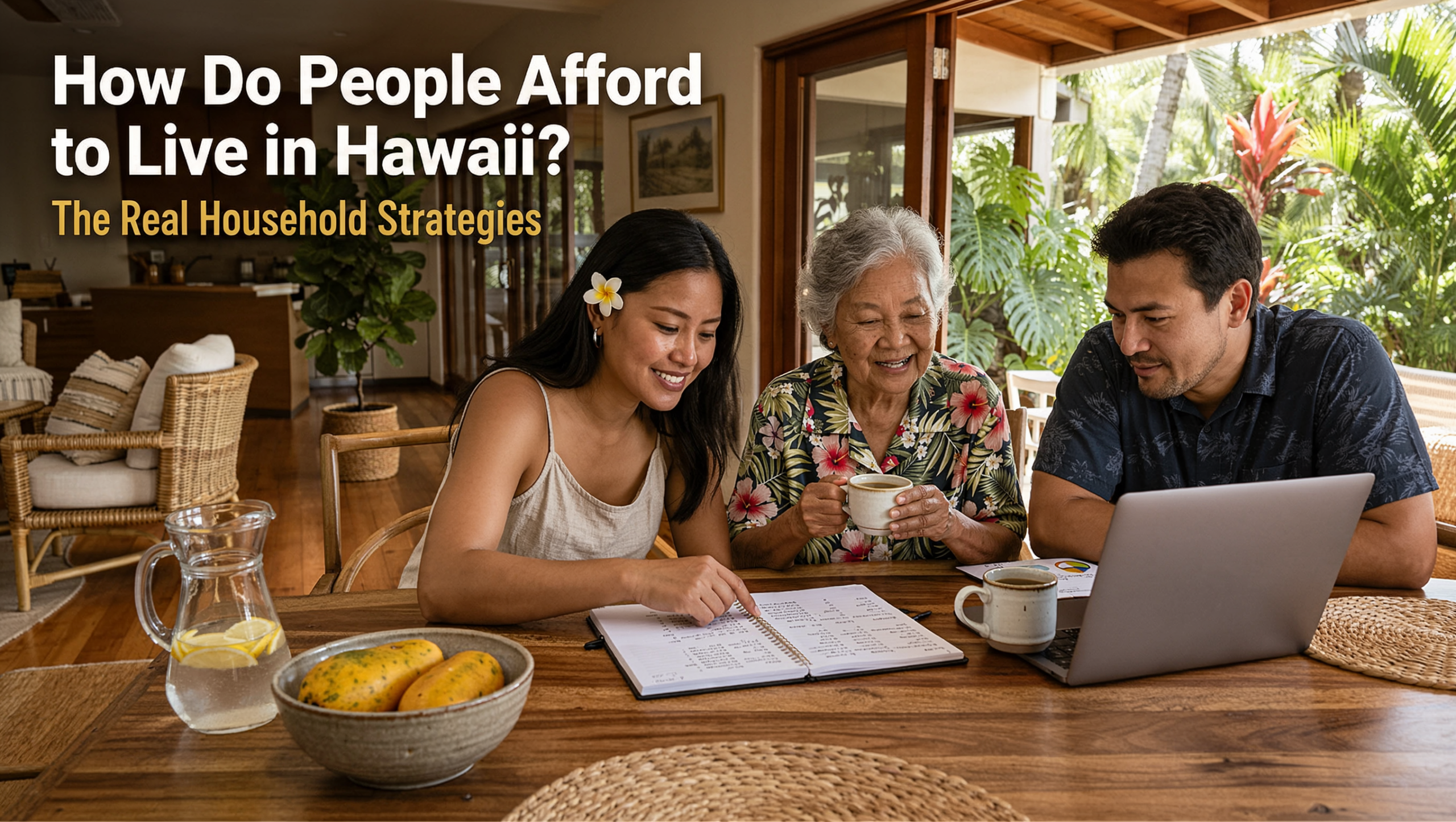
How Do People Afford to Live in Hawaii? The Real Household Strategies
It is the single most common question newcomers and prospective movers ask: how do people actually afford to live in Hawaii? When you look at the raw statistics from the outside, the numbers do not seem to add up. Median single-family home prices across Oahu consistently sit above one million dollars, a gallon of milk can easily set you back eight dollars, and electricity rates run nearly triple the national average. On paper, it looks like a mathematical impossibility for an average household to survive, let alone build a comfortable life here.
Take the Quiz: Is Hawaii Right For You? Meet with a Living in Hawaii Expert!
Yet over 1.4 million people call these islands home. They are not all trust fund beneficiaries, tech executives, or retired millionaires. The vast majority of our neighbors are teachers, nurses, municipal workers, tradespeople, small business owners, and hospitality staff. They raise children, save for college, buy homes, and build deep roots across the islands. They do not manage this through financial wizardry. Instead, they make it work through specific cultural habits, non-traditional household structures, intentional consumer choices, and clear trade-offs that look very different from typical Mainland living.
The Reality of the Island Cost Gap
To understand how households make the numbers work, we first have to look directly at the economic gap. According to data tracked by the State of Hawaii Department of Business, Economic Development and Tourism (DBEDT) as of mid-2026, the median household income in Hawaii sits around $94,000. Meanwhile, the median price for a single-family home on Oahu hovers near $1,050,000, and neighbor islands like Maui reflect similar or even higher pressure points in desirable districts.
If you apply conventional mainland real estate rules, such as spending no more than 28 percent of gross income on housing debt, a family earning the state median income would be priced out of almost every single-family home on the market. That reality leads many mainlanders to assume island life is reserved strictly for the ultra-wealthy. In reality, island residents survive and thrive by discarding mainland assumptions about housing, consumption, and wealth building.
Multi-Generational Living as an Economic Foundation
The single most powerful economic strategy in Hawaii is also its oldest cultural tradition: multi-generational living. While mainland culture often pushes young adults to establish separate, single-family households as soon as possible, local culture in Hawaii views shared living as both an emotional strength and a financial powerhouse.
According to census estimates, Hawaii consistently ranks among the top states for multi-generational households, with roughly 8 to 10 percent of all homes containing three or more generations. Under this arrangement, grandparents, adult children, and grandchildren share a single property. The financial benefits of this setup are transformative for household balance sheets:
-
Mortgage and Rent Sharing: Three or four working adults contributing to a single mortgage payment make an $800,000 or $1,200,000 property far more manageable than a couple trying to carry that balance alone.
-
Elimination of Childcare Costs: Childcare in Hawaii is among the most expensive in the country, often exceeding $1,500 to $2,000 per month per child. Grandparents providing daily care save the family tens of thousands of dollars in post-tax income each year.
-
Elder Care Without Facility Overhead: Families care for aging parents at home, avoiding the staggering costs of private assisted living facilities.
-
Shared Household Overhead: Internet, yard care, utility connection fees, and insurance policies are consolidated into one address rather than split across two or three separate apartments.
Many island homes feature attached studios, converted basements, or detached accessory dwelling units, commonly referred to locally as ohana units. These spaces allow family members to maintain privacy and personal autonomy while keeping collective living expenses remarkably low. For families without multi-generational ties, house hacking, such as renting out a studio apartment or a spare bedroom to a long-term tenant, serves the exact same economic purpose.
Dual Incomes, Side Hustles, and the Island Hustle
In many parts of the Mainland, a single earner can still comfortably support a family in a suburban home. In Hawaii, that model is an anomaly. The vast majority of stable households here rely on at least two full-time incomes, and very often, those earners maintain supplementary income streams.
Having a side hustle in Hawaii is not a desperate emergency response. It is a standard component of island lifestyle. A firefighter might operate a pressure-washing business on their off-shift days. An administrative assistant might bake custom goods for weekend baby showers or make floral arrangements. A teacher might tutor students or run weekend surf clinics. Because Hawaii has a year-round tourist economy and a tight-knit local community that values supporting neighbor-owned businesses, reliable craftspeople and service providers can build steady supplementary income through word of mouth.
In recent years, the expansion of remote employment has altered the landscape. An increasing share of island residents now work for Mainland companies based in Seattle, San Francisco, or Austin, pulling Mainland corporate salaries while living in Honolulu or Kailua. This strategy requires discipline due to the time-zone differences, as early morning calls starting at 5:00 AM are standard, but the wage premium helps bridge the local cost gap effectively.
The Island Grocery Playbook
Food is consistently the second largest budget shock for newcomers. Because roughly 85 to 90 percent of Hawaii’s food supply is shipped in across thousands of miles of ocean, grocery bills at conventional supermarkets can run 30 to 50 percent higher than on the Mainland.
People who make island life work over the long haul do not shop the way they did before arriving. They abandon the habit of driving to a single high-end grocery store once a week and loading up a cart with brand-name processed goods. Instead, successful households develop a deliberate Hawaii grocery shopping strategy that divides purchasing across multiple distinct channels.
Costco is essentially an island utility. Hawaii hosts some of the busiest Costco warehouses in the world because local residents use bulk buying to bypass mainland shipping surcharges on household staples like paper goods, eggs, dairy, rice, and cooking oils. Neighborhood families frequently split bulk packages of meat and dry goods to keep their per-unit costs down.
For fresh produce, seasoned residents bypass imported mainland berries and vegetables in favor of local open-air farmers markets, CSA subscriptions, and neighborhood fruit stands. Buying papayas, mangoes, local greens, and citrus directly from local growers is often significantly cheaper than buying imported, packaged produce at the grocery counter. Furthermore, a substantial portion of island protein comes from outside the commercial supply chain through weekend spearfishing, deep-sea fishing, and hunting.
Transportation Adjustments: Rightsizing the Garage
Transportation represents another major area where Hawaii households quietly trim thousands of dollars from their annual spending. The cost of car ownership in Hawaii runs higher than the national baseline due to elevated fuel costs, higher state registration fees, mandatory annual safety checks, and shipping surcharges on replacement parts.
To keep transportation budgets reasonable, many island families operate as single-car households, particularly in urban Honolulu where the public bus system (TheBus) and the Skyline rail system provide viable commuting alternatives. In neighborhoods where two vehicles are required, you will rarely see two brand-new financed sport utility vehicles sitting in the driveway of a financially savvy household.
Instead, residents often drive reliable, paid-off Japanese sedans and compact pickup trucks that endure the salty sea air without incurring a $700 monthly auto loan payment. The culture in Hawaii does not place high social status on driving a pristine luxury car. In fact, a sun-faded Toyota Tacoma with a few dings from surfboard racks is widely recognized as the unofficial vehicle of the islands, carrying zero pretension and minimal insurance costs.
Offsetting Electricity with Solar Power
Utility bills in Hawaii can easily shock an unprepared household. Because the state historically relied on imported oil for electricity generation, rates across the islands frequently hover between 38 and 45 cents per kilowatt-hour, compared to a national average closer to 16 cents. Running central air conditioning around the clock in an unshaded home can easily produce a monthly electricity bill topping $600 to $900.
Long-term homeowners and proactive landlords combat this reality through rooftop solar installations paired with modern battery storage systems. By capturing the abundant year-round tropical sunshine, households can drop their monthly electrical utility expense down to the basic utility connection fee, which is often around $25 to $35 per month. For renters who cannot install solar, the strategy involves architectural adaptation: positioning floor fans to catch prevailing trade winds, using heavy blackout curtains during peak afternoon sun, and reserving air conditioning use strictly for bedroom sleeping hours during the warmest late-summer months.
Rethinking Housing Choices and Property Taxes
Housing will always remain the heaviest financial lift in Hawaii, but long-term residents use specific structural factors to make it work. For those who do not own, mastering the rental market is crucial. Securing fair housing rates requires understanding neighborhood lease timing and finding landlords through local networks rather than relying exclusively on national rental aggregators. If you are currently evaluating the rental landscape, our guide to finding long-term rentals in Hawaii provides a roadmap for navigating local listings and avoiding costly landlord markups.
For those working toward homeownership, there is an often-overlooked silver lining in the island tax code: Hawaii property taxes are among the lowest in the entire United States. While mainland homeowners in states like Texas, New Jersey, or Illinois might pay 1.8 to 2.5 percent of their assessed home value in annual property taxes, owner-occupant rates across Hawaii counties typically sit below 0.35 percent, bolstered by generous basic homeowner exemptions. On an $800,000 home, an owner-occupant in Honolulu might pay less than $2,500 per year in real property taxes, saving hundreds of dollars per month compared to an equivalent mainland property.
The Mindset Shift: What Islanders Choose to Sacrifice
Ultimately, affording to live in Hawaii is not solely a question of earning more money. It is a matter of reallocating what you value. The people who thrive here over decades make conscious trade-offs that many mainlanders are unwilling to make.
Residents happily trade away square footage. A family that might expect a 3,500-square-foot suburban home on a half-acre lot in Georgia or Ohio willingly lives in a 1,200-square-foot home or a two-bedroom condominium in Hawaii. When the weather is 80 degrees and sunny for ten months of the year, your true living room is the lanai, the beach park, the hiking trail, and the ocean.
Island residents also spend far less on consumer goods, seasonal wardrobes, and expensive commercial entertainment. You do not need winter coats, snow tires, heating oil, or expensive lawn-care services. Entertainment in Hawaii is uniquely democratic and largely free. A weekend spent surfing at dawn, barbecuing with friends at a beach park, hiking a ridgeline, or watching the sunset with neighbors costs almost nothing beyond a cooler of ice, some marinated meat, and a bag of charcoal.
Building Your Financial Runway for Hawaii
If you are planning a move to the islands, you should never attempt the transition on financial hope alone. Thriving here requires a calculated foundation before your plane touches down on the tarmac:
-
Build a Six-Month Emergency Reserve: Island economies are subject to shipping disruptions, tourism fluctuations, and unexpected price shocks. Having an untouchable reserve parked in a high-yield account prevents an unexpected car repair or medical bill from turning into a one-way ticket back to the Mainland.
-
Eliminate High-Interest Consumer Debt: Carrying credit card balances or high-interest auto loans into an island budget is the fastest route to financial burnout. Clear your debt slate before taking on the island cost of living.
-
Audit Your Consumption Habits: If your happiness requires frequent trips to high-end shopping centers, climate-controlled mega-mansions, and driving the newest luxury vehicle, island life will feel financially suffocating. If you derive joy from outdoor recreation, simple shared meals, and community connections, the trade-off will feel like an upgrade.
-
Connect with Local Networks: Island life operates on relationships. The best rental deals, reliable trade services, and employment opportunities rarely appear on mainland job boards. They are shared through local word of mouth once you demonstrate respect for the community and a commitment to staying long-term.
Living in Hawaii is an active choice. The people who make it work do not pretend the expenses do not exist. Instead, they choose simplicity over status, community over isolation, and natural abundance over material accumulation. When approached with intentionality, humility, and realistic budgeting, building a sustainable and rewarding life in the islands is entirely within reach.
Leave A Comment