
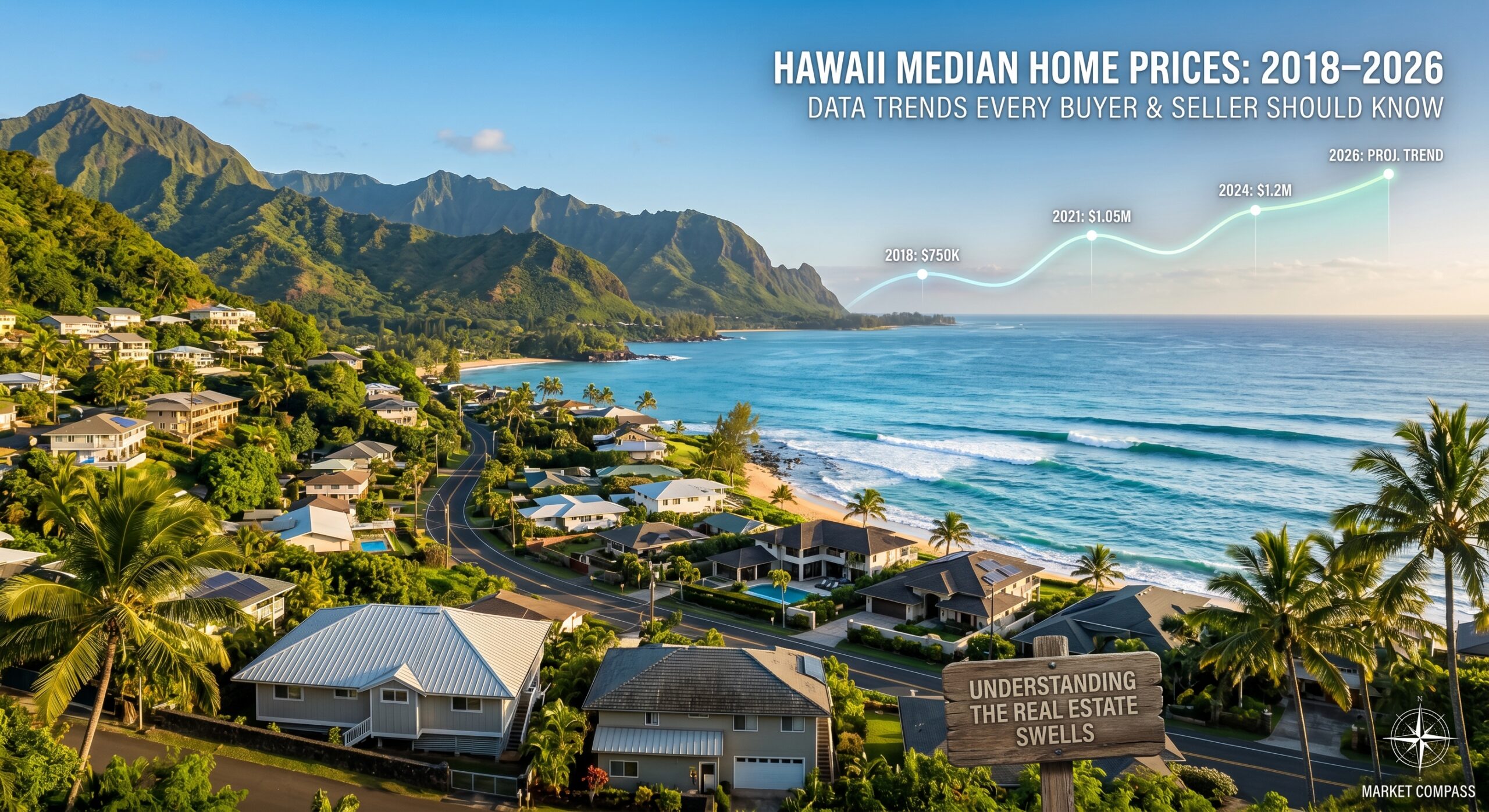
Hawaii Median Home Prices 2018–2026: Data Trends Every Buyer & Seller Should Know
Introduction: Understanding the Hawaii Real Estate Landscape
Navigating the Hawaii real estate market can feel like trying to read the ocean swells. Just when you think you understand the rhythm, a new set of waves rolls in and changes the entire dynamic. Whether you are planning a move from the Mainland, looking to upgrade your current island home, or considering selling your property, having a firm grasp of historical data is your best compass. Over the last decade, the islands have experienced some of the most dramatic real estate shifts in modern history, making a thorough analysis of the hawaii home prices history more valuable than ever.
Between 2018 and 2026, Hawaii housing went through a distinct series of phases: steady pre-pandemic growth, an unprecedented buying frenzy, a sharp interest rate shock, and finally, the highly resilient stabilization we see today. This post will break down the numbers, utilize data from trusted local institutions like the Honolulu Board of Realtors (HBR) and the University of Hawaii Economic Research Organization (UHERO), and provide the practical context you need to make informed decisions in this unique market.
The Chronological Journey: Hawaii Home Prices History (2018–2026)
To understand where the market stands today in 2026, we must look back at how we arrived here. The trajectory of Hawaii real estate over the past eight years is not just a story of supply and demand: it is a reflection of global economic shifts playing out on a chain of geographically isolated islands.
2018–2019: The Baseline of Steady Growth
In the years immediately preceding the pandemic, the Hawaii housing market was characterized by healthy, predictable growth. On Oahu, the median sales price for a single-family home hovered in the high $700,000s, while condominiums sat comfortably in the low $400,000s. Inventory was relatively balanced, and buyers typically had room to negotiate. During this era, the market was driven primarily by local move-up buyers, military families utilizing VA loans, and a steady stream of Mainland buyers looking for retirement or vacation homes. It was a stable environment where price appreciation matched historical averages of three to five percent annually.
2020–2022: The Pandemic Boom and Historic Peaks
The arrival of 2020 completely rewrote the real estate playbook. As remote work became a permanent reality for millions of professionals on the Mainland, the appeal of island life skyrocketed. Coupled with historically low interest rates, which dropped below three percent, demand surged to unprecedented levels. Buyers flooded the market, resulting in intense bidding wars, offers waivered of home inspections, and properties selling for hundreds of thousands of dollars over asking price.
By the summer of 2022, the median price for a single-family home on Oahu peaked at an astonishing $1,150,000, while Maui and Kauai saw even more aggressive climbs. Inventory dwindled to mere days of supply. This period established a new, highly elevated baseline for Hawaii property values, effectively pricing out many local families who did not already own real estate.
2023–2024: The Rate Shock and Inventory Freeze
To combat inflation, the Federal Reserve aggressively raised interest rates starting in late 2022 and continuing through 2023. Mortgage rates quickly doubled, climbing from the three percent range to over seven percent. In a typical real estate market, such a sharp increase in borrowing costs triggers a significant drop in home prices. However, Hawaii’s market reacted differently due to a phenomenon known as the lock-in effect.
Existing homeowners who secured two or three percent mortgage rates during the boom refused to sell, realizing that moving would mean trading their low rate for one more than twice as high. Consequently, new listings plummeted. This severe inventory shortage kept prices incredibly sticky. While sales volume dropped by thirty to forty percent, median prices only experienced minor single-digit corrections before stabilizing, defying national expectations of a major crash.
2025–2026: The New Normal and Market Stabilization
As we move through 2026, the market has entered a phase of mature stabilization. Buyers and sellers have finally accepted that the ultra-low rates of the pandemic era are gone, and mortgage rates have settled into a steadier range. Inventory remains historically low but has begun to slowly recover as life changes: such as job transfers, retirements, and growing families: force some movement.
Today, the median single-family home price across the state remains firmly above the million-dollar mark on the most populated islands. It is a highly competitive, low-inventory environment where properties that are priced correctly and in good condition still attract multiple offers, while overpriced or neglected homes sit on the market much longer than they did a few years ago.
Island-by-Island Deep Dive: Median Price Trends
It is important to remember that there is no single Hawaii real estate market. Each island is its own micro-market with distinct economic drivers, inventory levels, and buyer demographics. Let us examine the median single-family home price trends across the four major counties from 2018 to 2026.
Oahu (Honolulu County)
Oahu is home to the majority of the state’s population and features the most diverse economy. Because of its robust infrastructure, military presence, and job market, Oahu’s real estate market tends to be the most stable and resilient during economic downturns.
-
2018 Median SFH Price: $790,000
-
2020 Median SFH Price: $830,000
-
2022 Median SFH Price: $1,110,000
-
2024 Median SFH Price: $1,050,000
-
2026 Median SFH Price: $1,100,000
On Oahu, the demand for housing remains incredibly high, particularly in family-friendly neighborhoods like Mililani, Kapolei, and Kailua. The condominium market has also seen steady demand, with the median price stabilizing around $510,000 in 2026, offering a more accessible entry point for first-time buyers and downsizers.
Maui County
Maui’s real estate market has historically been heavily influenced by second-home buyers and luxury investors. The market experienced massive appreciation during the pandemic, and the tragic Lahaina wildfires of late 2023 added an incredibly complex layer of inventory constraints and housing displacement.
-
2018 Median SFH Price: $710,000
-
2020 Median SFH Price: $770,000
-
2022 Median SFH Price: $1,100,000
-
2024 Median SFH Price: $1,200,000
-
2026 Median SFH Price: $1,250,000
Because of the severe housing shortage exacerbated by the rebuilding efforts, Maui currently commands some of the highest median home prices in the state. The rental market is similarly strained, making housing affordability a primary topic of local policy discussions.
Hawaii Island (The Big Island)
The Big Island offers the most diverse geographic landscapes and, historically, the most affordable real estate in the state. However, the vast size of the island means that prices vary wildly between the sunny, resort-heavy Kona side and the lush, rainier Hilo side.
-
2018 Median SFH Price: $355,000
-
2020 Median SFH Price: $400,000
-
2022 Median SFH Price: $500,000
-
2024 Median SFH Price: $520,000
-
2026 Median SFH Price: $545,000
While the Big Island remains the most affordable option, its median prices have still climbed significantly since 2018. Buyers here must also navigate unique regional factors, such as lava zones and catchment water systems, which can impact insurance and financing options.
Kauai County
Kauai is characterized by strict development limits, a small population, and breathtaking natural beauty. These factors combine to create a highly exclusive real estate market with extremely low inventory, where even minor shifts in demand can cause large swings in median prices.
-
2018 Median SFH Price: $685,000
-
2020 Median SFH Price: $810,000
-
2022 Median SFH Price: $1,150,000
-
2024 Median SFH Price: $1,200,000
-
2026 Median SFH Price: $1,225,000
Kauai’s market is heavily driven by off-island buyers seeking luxury estates and vacation homes, keeping prices elevated and making competitive entry difficult for local buyers.
The Structural Drivers of Hawaii’s Elevated Prices
To truly understand the hawaii home prices history, one must look beyond standard market cycles and analyze the structural forces that keep Hawaii real estate among the most expensive in the nation. There are three primary drivers that dictate this unique economic landscape.
First and foremost is the absolute constraint of land. Hawaii is an archipelago, and the amount of buildable land is strictly limited by mountainous terrain, agricultural preservation laws, and conservation zones. Unlike mainland metropolitan areas that can expand outward into surrounding suburbs, Hawaii’s boundaries are defined by the Pacific Ocean. This geographical reality creates a permanent supply deficit.
Second, the cost of construction in Hawaii is exceptionally high. Because we are isolated in the middle of the Pacific, virtually all building materials: from lumber and steel to drywall and fixtures: must be shipped in from the Mainland or international ports. This logistical challenge, combined with a highly competitive local labor market, makes building or remodeling a home incredibly expensive. If existing home prices seem daunting, you might consider evaluating the real cost of building a home in Hawaii to see if custom construction is a viable path for your goals.
Finally, Hawaii’s global appeal ensures a constant stream of out-of-state demand. Buyers from the Mainland United States, Canada, and Asia view Hawaii real estate as a safe, highly desirable place to store wealth and enjoy an unparalleled lifestyle. This external demand competes directly with local buyers, consistently putting upward pressure on home prices.
The Hidden Costs of Buying in Hawaii
When analyzing Hawaii home price trends, buyers often focus solely on the list price or the mortgage payment. However, owning property in the islands comes with unique carrying costs that must be factored into your long-term financial planning.
One area where Hawaii property owners receive a bit of relief is property taxes. Hawaii boasts some of the lowest residential property tax rates in the nation. However, because the assessed home values are so high, the actual dollar amount paid can still be substantial. Before making an offer on a home, it is essential to understand how property taxes work in Hawaii, as rates vary significantly depending on whether the home is your primary residence or a secondary investment property.
On the other hand, homeownership costs can be heavily impacted by association fees. Many neighborhoods, townhome complexes, and condominiums are part of planned communities that require monthly dues. Additionally, if you are looking at condominiums or planned developments, understanding HOA fees in Hawaii is critical, as these monthly charges can range from a couple of hundred dollars to well over a thousand dollars, directly affecting your monthly purchasing power and debt-to-income ratios.
Pros and Cons of Entering the 2026 Hawaii Market
Deciding whether to buy or sell in today’s market requires weighing the current economic realities against your personal and financial goals. Here is a breakdown of the primary advantages and challenges of entering the Hawaii real estate market in 2026.
Pros of Buying in Hawaii Today
-
Long-Term Wealth Preservation: Historically, Hawaii real estate has proven to be an excellent hedge against inflation, with prices consistently recovering and growing over multi-decade periods.
-
Unmatched Quality of Life: Owning a home in Hawaii provides permanent access to a healthy, outdoor-oriented lifestyle, a warm community spirit, and incredible natural beauty.
-
Stable Rental Demand: For investors or those looking to rent out a portion of their home, the persistent housing shortage ensures a steady pool of long-term renters.
Cons of Buying in Hawaii Today
-
High Barrier to Entry: With median prices hovering around one million dollars on the major islands, saving for a down payment and qualifying for a loan requires significant financial resources.
-
Limited Inventory: Buyers must be patient, as the selection of homes in desirable neighborhoods remains tight, often leading to competitive bidding situations for prime properties.
-
Elevated Borrowing Costs: While interest rates have stabilized compared to their 2023 peaks, they remain significantly higher than the historic lows of the pandemic era, increasing monthly payments.
Strategic Advice for Buyers and Sellers in 2026
If you are planning to buy in Hawaii, preparation is your greatest asset. Do not wait until you find the perfect home to organize your finances. Work with a highly experienced local lender who understands the nuances of Hawaii properties, including leasehold estates, condotels, and unique regional zoning. Get fully pre-approved, understand your maximum monthly budget, and be prepared to act quickly when a well-priced home enters the market. Most importantly, remain patient: finding the right home in a low-inventory market is a marathon, not a sprint.
For sellers, the key to success in 2026 is realistic pricing and immaculate presentation. The days of putting a sign in the yard and receiving ten over-asking offers within forty-eight hours are largely behind us. Today’s buyers are highly sensitive to price and interest rates. A home that is priced correctly will still attract strong interest, while an overpriced home will quickly become stale, forcing price reductions later on. Partner with an agent who utilizes professional photography, virtual tours, and targeted marketing to showcase your home’s unique value to both local and Mainland buyers.
Ultimately, the Hawaii real estate market remains one of the most dynamic and rewarding landscapes in the world. By understanding the historical data trends from 2018 to 2026, you can approach your next real estate transaction with clarity, confidence, and a realistic vision for your future in the islands.

Leave A Comment