
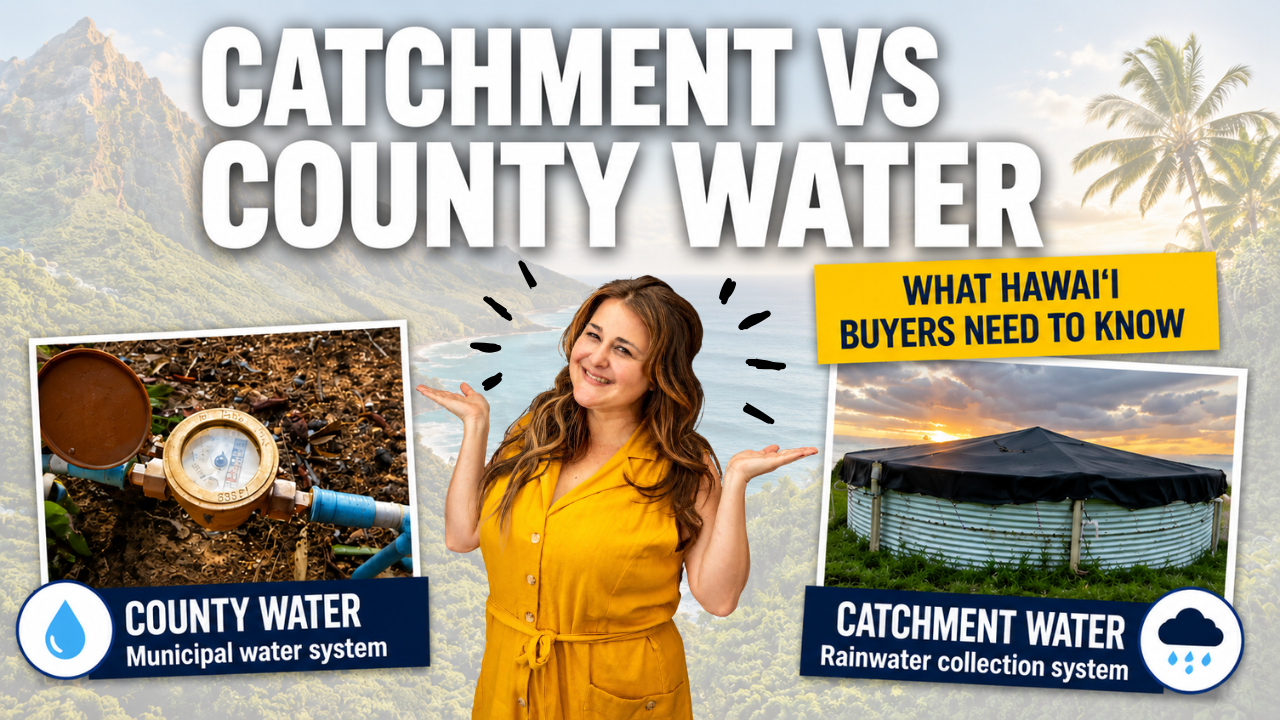
Catchment vs County Water in Hawaii: What Buyers Need to Know
When people picture life on Hawaiʻi Island, they imagine the rain. The lush windward valleys, the mist rolling off the mountain, the sound of it on a metal roof at night.
What most buyers do not realize until they are deep into a property search is that all of that rain is not just scenery. For tens of thousands of people living on this island, it is their entire water supply.
Water is one of the first questions I ask when a client calls me about a property.
Not because it is a problem.
Because it shapes everything else about how you live on that land. And whether a property draws from a county line or a catchment tank is one of the most important distinctions a buyer on Hawaiʻi Island needs to understand before making an offer.
Where County Water Reaches and Where It Doesn’t
County water service, managed by the Hawaiʻi County Department of Water Supply, is not available everywhere on the island. It is concentrated in developed corridors, primarily in Kona, parts of Waimea, and select areas of Hilo. Once you move into the rural subdivisions of Puna, Kaʻu, and the district surrounding Ocean View, county water lines do not follow you.
Entire communities in lower Puna run exclusively on catchment. Hawaiian Paradise Park, Orchidland Estates, Hawaiian Acres, Leilani Estates. The same is true across Kaʻu, including much of Ocean View and the areas surrounding Pahala.
If a property is connected to county water, that comes with a one-time facilities charge connection fee and ongoing rates per thousand gallons. It is metered, it is regulated, and for many buyers, it feels familiar. But it is not always available, and in some of the most desirable agricultural areas on the island, it simply does not exist.
How a Catchment System Actually Works
A catchment system is exactly what it sounds like. Rain falls on your roof, moves through gutters, passes through a first-flush diverter that removes the initial contaminated runoff, and then flows into large storage tanks. From there, a pump pushes the water through a multi-stage filtration system, typically sediment filters, carbon filters, and UV sterilization, before it reaches your tap.
Between 30,000 and 60,000 people on Hawaiʻi Island rely on this system for their daily water needs. It is not a fringe lifestyle. It is standard infrastructure across wide portions of the island.
One thing buyers often overlook: the roof material matters. Asphalt shingles are not recommended for catchment systems because they can leach compounds into your water supply over time. Metal roofing is the standard for catchment homes, and it is worth confirming this on any property you are seriously considering.
Tank Size, Rainfall, and the Dry Area Problem
Storage capacity is where catchment systems live or die. Most catchment homes on the island carry between 10,000 and 30,000 gallons of storage. Most insurance carriers require a minimum of 8,000 gallons. For a family using water normally, a 10,000-gallon tank is a reasonable baseline in a wet area.
But not every part of the island is wet.
Ocean View sits in one of the drier catchment zones on the island. Properties there often require 40,000 gallons or more of storage capacity to bridge dry periods safely. When I am working with buyers in that area, I always talk through this. The land may be affordable. The infrastructure to support your water needs may not be. Understanding your microclimate and matching your storage to it is not optional. It is survival planning.
What Catchment Costs to Install and Maintain
A new catchment system on Hawaiʻi Island typically runs between $7,000 and $20,000 to install, depending on tank size, site conditions, and filtration requirements. Larger systems can run $30,000 or more.
Ongoing maintenance is manageable. UV bulb replacements run roughly $70 to $90 per year. Filters average $15 to $20 per month. Pump electricity costs around $10 to $15 per month. All in, a well-maintained catchment system costs most households between $400 and $1,800 per year to operate.
Compared to a county water bill averaging $40 to $50 per month, the ongoing costs of catchment are competitive. The difference is that catchment requires you to be an active steward of your water system. There is no utility company watching over it. That responsibility sits with you.
What to Look for When Evaluating a Catchment Property
When I walk a catchment property with a buyer, there are five things I want to understand before we go any further.
- How old is the tank, and what is its capacity? A cracked or undersized tank is an immediate capital cost waiting to happen.
- What is the roof material? Metal is what you want. Asphalt shingles are a red flag.
- Is there a functioning multi-stage filtration system, including UV? If not, budget for it.
- What is the average annual rainfall at this specific location? Microclimate data matters more than district averages.
- Has the water been tested recently? The state of Hawaiʻi does not regulate individual catchment systems. That means testing is on you, and it matters.
Water is one of the most important due diligence items on any rural or agricultural property in Hawaiʻi. If you are evaluating land or a home and want to understand what the water situation really means for your plans, I would be happy to walk you through it.
And if you already own a catchment property and are considering selling, positioning your system correctly in the listing makes a real difference. A well-maintained tank, a quality filtration setup, and documented water testing are assets. When those pieces are clearly communicated to buyers, it builds confidence and often leads to stronger offers.
Leave A Comment