

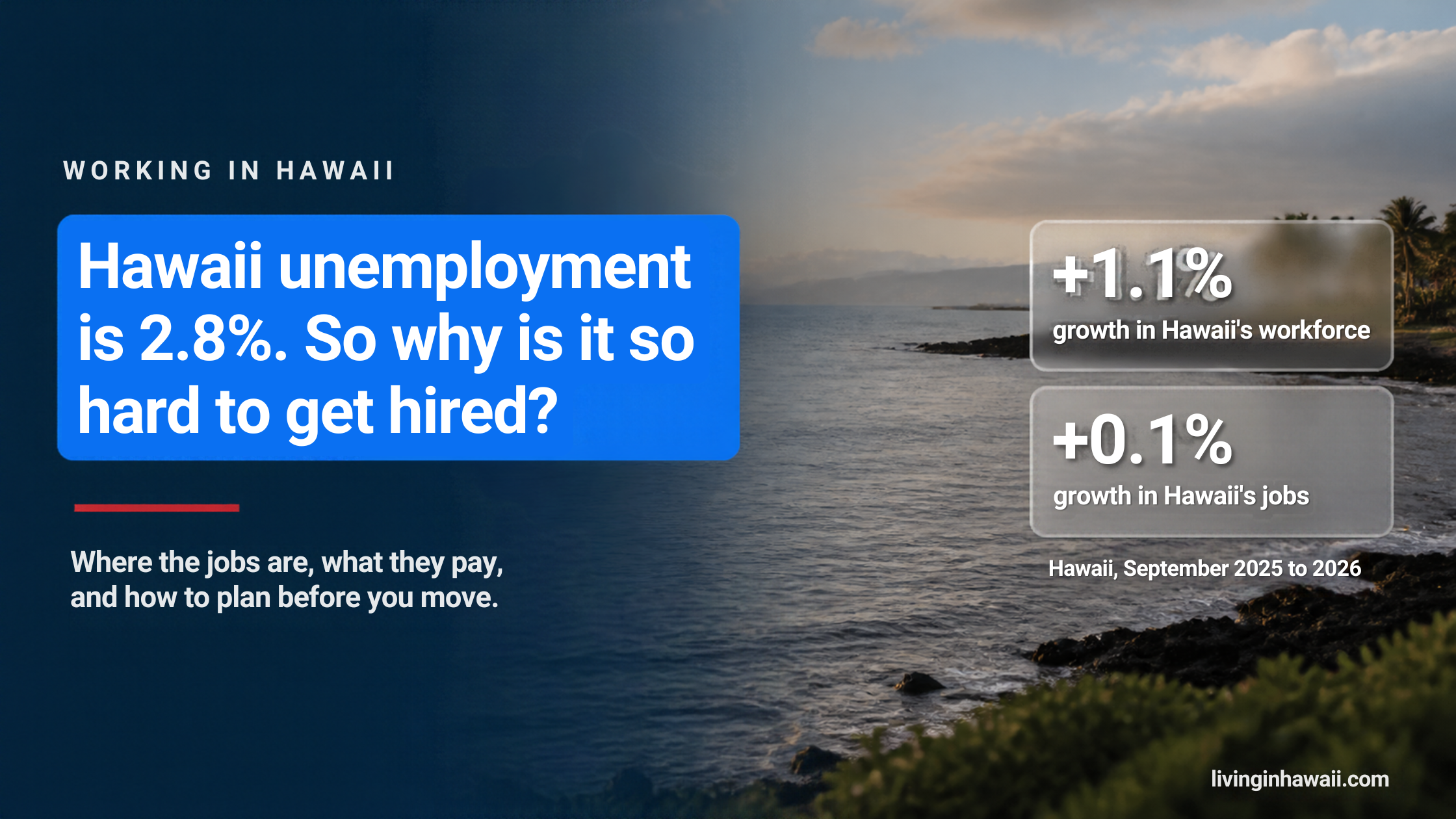
Hawaii Unemployment Is 2.8%. So Why Is It So Hard to Get Hired?
Hawaii’s unemployment rate was 2.8% in September 2026, the fifth lowest in the country. On paper, that sounds like jobs are everywhere. People who move here and start applying often find the opposite. Both things are true, and the gap between them is worth understanding before you plan a move around a job search.
Take the Quiz: Is Hawaii Right For You? Meet with a Living in Hawaii Expert!
At a glance
- Unemployment: 2.8% statewide (September 2026), up from 2.1% a year earlier.
- Job growth: 642,400 payroll jobs, up just 400 (0.1%) in a year.
- Why it’s hard: more people are looking for work, and the number of jobs isn’t growing to match.
- Where pay beats the mainland: healthcare, construction and service work.
- Where it trails: tech and management roles pay less than the national average.
- Best move: line up the job, or keep a remote one, before you move.
A low rate in a market that isn’t growing
A low unemployment rate measures how many people who want work can’t find it. It doesn’t measure how many openings exist. In Hawaii, those two numbers have drifted apart.
Over the past year, Hawaii’s labor force grew 1.1%, to 694,900 people, the most since 2018. Employment grew only 0.4%. More people are looking, and the jobs aren’t keeping pace. The state’s former chief economist, Eugene Tian, describes it as labor supply outpacing demand, with rising prices pulling more people back into the workforce. Honolulu prices rose 5.2% in the year through September, compared with 3.7% nationally.
The total job count tells the same story. Hawaii had 642,400 payroll jobs in September, unchanged from August and up only 400 from a year earlier. Federal jobs, a big employer here, fell by 2,700 over the year. Hospitality (up 2,100) and private education and healthcare (up 2,000) did most of the hiring.
The rate also varies by island. In September it was 3.0% in Honolulu, 3.1% in Maui County and 3.5% in Hawaii County. Kauai jumped to 5.1% after Hurricane Lowell.
Few openings, and people stay put. In a small market where jobs aren’t being added, good positions open up when someone leaves. In a place people work hard to stay, that doesn’t happen often.
Employers favor people who are already here. Hiring someone from the mainland is a risk, because some newcomers leave within a year or two. An applicant with a local address and a clear plan to stay often wins over a stronger resume from out of state.
Relationships carry weight. On islands this size, a lot of hiring happens through people who know each other. Someone who can vouch for you counts for more than it would in a large mainland city.
Some licenses don’t transfer. Hawaii is not part of the multistate nurse licensing compact, so nurses need a Hawaii license before they can work. Check licensing rules for your field early, because it can take months.
Where the pay is, and where it isn’t
Average pay in Honolulu is slightly higher than the national average, $34.59 an hour versus $33.54. That average hides big differences by field.
| Field | Honolulu avg. hourly | U.S. avg. hourly |
|---|---|---|
| Healthcare practitioners | $62.04 | $52.26 |
| Construction | $40.71 | $31.42 |
| Healthcare support | $23.50 | $19.62 |
| Food preparation and serving | $22.20 | $17.86 |
| Management | $63.26 | $69.84 |
| Computer and math | $49.70 | $57.73 |
Source: U.S. Bureau of Labor Statistics, Urban Honolulu, May 2025.
Healthcare and the trades pay well above the mainland. Food service is also a bigger share of jobs here, about 12% of Honolulu employment compared with under 9% nationally. Tech and management are the opposite: fewer jobs, and lower pay than you’d earn on the mainland. If you work in tech and can keep a mainland salary remotely, that is usually the better option.
What working here gets you
- Employer health coverage. Under Hawaii’s Prepaid Health Care Act, employers must offer health insurance once you work 20 or more hours a week for four weeks in a row, and your share of the premium is capped at 1.5% of your wages.
- A rising minimum wage. It’s $16 an hour now and goes to $18 in 2028.
- Strong unions. About 1 in 4 Hawaii workers belongs to a union (24.8% in 2025), compared with 10% nationally.
How to plan the job side of your move
- Keep your remote job if you can. Mainland pay with a Hawaii address is the strongest position to be in.
- Line up work before you move. “I’ll figure it out when I get there” is the plan that sends a lot of people back.
- Start your license transfer early if you work in healthcare, teaching, real estate or a trade.
- Visit to interview in person. Showing up tells an employer you’re serious about staying.
- Budget for a longer search. Plan for a few months of expenses while you look.
Watch the short version
We broke this down on Instagram. Comment JOBS on the reel and we’ll send you our free cheat sheet: who’s hiring, what each role pays, and the remote-work rules that surprise people.
Keep reading
- Finding jobs in Hawaii
- The highest-paying jobs in Hawaii in 2026
- Finding a job in Hawaii before you move
- Remote working in Hawaii
Sources: Hawaii Department of Business, Economic Development and Tourism (September 2026 labor force and jobs release); U.S. Bureau of Labor Statistics (Occupational Employment and Wages, Urban Honolulu, May 2025; Union Members 2025); Honolulu Star-Advertiser, October 23, 2026.
Leave A Comment