
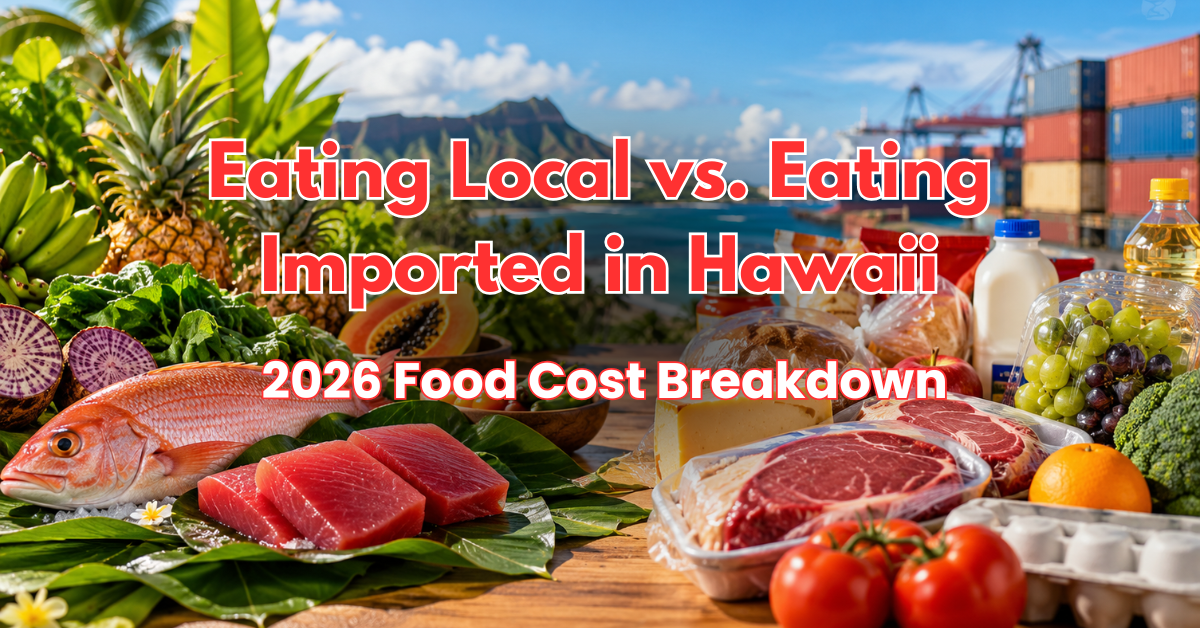
Eating Local vs. Eating Imported in Hawaii: 2026 Food Cost Breakdown
When newcomers step into a Hawaii grocery store for the very first time, the experience often triggers immediate sticker shock. Gallons of milk priced over seven dollars, standard boxes of breakfast cereal reaching double digits, and modest heads of iceberg lettuce priced like specialty gourmet items can quickly upend an unprepared household budget. For decades, the conventional wisdom suggested that living on an island simply means paying a blanket 30 to 50 percent markup on everything you consume.
Take the Quiz: Is Hawaii Right For You? Meet with a Living in Hawaii Expert!
However, that broad assumption misses a critical distinction that seasoned island residents understand well. Hawaii imports roughly 85 to 90 percent of its food supply, making the cost of imported goods heavily dependent on ocean freight, refrigerated container logistics, and mainland inflation. At the same time, the state agriculture sector produces an abundance of tropical fruits, pasture-raised proteins, island vegetables, and specialty starches that follow completely different economic drivers. Understanding the real financial difference between eating local and eating imported in 2026 is essential for anyone trying to build a sustainable life in the islands.
The Economics of Island Food in 2026
To understand food prices in Hawaii, you have to examine the supply chain that connects the islands to the outside world. Nearly all imported dry goods, dairy products, processed foods, and mainland produce travel thousands of miles across the Pacific Ocean on container ships. Shipping costs include ocean freight rates, maritime fuel surcharges, terminal handling fees, and the extra refrigeration costs required to keep perishable items fresh across a multi-day voyage. When mainland consumer price index data shows food inflation, those increases are amplified by the time the product lands on grocery shelves in Honolulu, Kahului, or Hilo.
According to data from the United States Department of Agriculture (USDA) Economic Research Service and agricultural market reports from the Hawaii Department of Agriculture (DOA), Hawaii grocery prices consistently rank highest in the nation. In 2026, the average cost of an imported grocery basket in urban Honolulu sits approximately 42 percent above the national mainland average. When crude oil and maritime shipping rates fluctuate, those ocean-bound goods absorb the cost shock almost immediately.
Conversely, island-grown food operates on a different economic model. Local farmers face extraordinarily high costs for farm labor, commercial land leases, water, and imported fertilizers or livestock feed. Yet local growers do not have to pay thousands of dollars per container for trans-Pacific refrigerated shipping, nor do their products spend a week losing freshness in transit. The resulting dynamic creates surprising pricing inversions where certain local foods are actually cheaper than their imported counterparts, while other local staples remain premium items.
Produce: When Local Farming Beats Mainland Imports
Fresh produce is the category where the difference between local and imported shopping becomes most apparent. When mainland produce is harvested, packed, shipped by rail or truck to West Coast ports, loaded onto container ships, and distributed across Hawaii, grocers build high spoilage buffers into their shelf pricing. A container of California strawberries or leafy greens often suffers noticeable spoilage before it even reaches store shelves, and consumers ultimately pay for that waste.
The Hawaii Department of Agriculture regularly tracks wholesale and retail commodity pricing across key produce items. In 2026, locally cultivated tropical fruits and island-grown greens consistently match or beat imported mainland equivalents in value per edible pound. Bananas, papayas, citrus, avocados, and certain specialty greens thrive in Hawaii microclimates, reducing the transportation overhead to simple inter-island or regional truck delivery.
-
Bananas: Standard imported Cavendish bananas from Central America or California average $1.49 to $1.89 per pound at major supermarkets. Local apple bananas, purchased at neighborhood farmers markets or regional roadside stands, generally run between $1.75 and $2.50 per pound. While slightly higher per pound, apple bananas last significantly longer on the counter and offer a richer flavor and denser texture that makes them far more filling.
-
Papayas and Tropical Fruits: Local Rainbow papayas frequently sell for $1.00 to $1.75 per pound across the islands, with bulk bags at farm stands dropping even lower. By contrast, imported stone fruits like mainland peaches, plums, and nectarines regularly exceed $4.99 to $6.50 per pound, frequently arriving mealy or bruised from the journey.
-
Leafy Greens and Lettuces: Commercial mainland iceberg and romaine heads often sit between $3.49 and $4.99 each. Local hydroponic lettuce, grown on Oahu, Maui, and Hawaii Island, typically sells for $3.99 to $4.50 per living head with roots attached. Because the local hydroponic greens remain fresh in home refrigerators for two to three weeks longer than ocean-shipped mainland greens, the effective cost per usable leaf is noticeably lower.
-
Avocados: Imported Hass avocados frequently cost $2.00 to $3.00 each for small, firm specimens. In contrast, massive local butter avocados, which often weigh one to two pounds each, can be found at neighborhood markets for $2.00 to $4.00 apiece during peak season. On a volume-per-dollar basis, local avocados represent a massive financial win.
If you want to dive deeper into practical retail shopping destinations across the state, read our companion breakdown on the Hawaii Grocery Strategy 2026: Where to Shop for Best Prices, which examines how wholesale clubs and discount markets fit into a weekly budget.
Proteins: Beef, Poultry, Pork, and Island Seafood
Protein makes up the largest dollar share of most household food budgets, and the pricing dynamics between local and imported proteins in 2026 reveal clear trade-offs between convenience and cost. The livestock sector in Hawaii has undergone substantial changes over the past decade, with expanded local processing facilities and a renewed focus on pasture-raised beef and diversified pork production.
Island cattle operations on the Big Island, Maui, and Kauai produce world-class grass-fed beef. Because these animals graze on open pasture rather than grain feedlots, local beef requires fewer imported grain shipments. In 2026, local ground grass-fed beef sells at specialty butchers, community food hubs, and local grocers for approximately $7.50 to $9.00 per pound. Conventional imported corn-fed ground beef at standard supermarkets ranges from $5.99 to $7.49 per pound, while imported organic grass-fed beef from the Mainland easily tops $10.00 to $12.00 per pound. For households prioritizing pasture-raised, hormone-free meats, buying local beef is frequently the cheaper option.
Poultry tells a very different story. Hawaii lacks the grain infrastructure needed to raise industrial poultry at scale, meaning nearly all commercial chicken sold in the islands is imported. Frozen or chilled mainland chicken breasts purchased in family packs at bulk stores remain one of the cheapest protein sources on the islands at $3.29 to $4.49 per pound. The small number of local pasture-raised poultry farms produce premium birds that retail between $8.00 and $12.00 per pound, making local chicken an occasional artisan purchase rather than an everyday budget staple.
Seafood represents a dynamic middle ground. Fresh wild-caught island fish, including yellowfin tuna (ahi), mahi-mahimahi, wahoo (ono), and opah, fluctuates based on seasonal catch volumes and weather patterns. While top-grade ahi sashimi can fetch upwards of $24.00 to $35.00 per pound at high-end counters, local poke counters and fish markets frequently offer fresh daily catch cuts, poke trims, and whole fish between $12.00 and $18.00 per pound. When compared to thawed, imported mainland salmon or farm-raised foreign whitefish that often sells for $14.00 to $19.00 per pound, local fresh catch provides superior culinary quality and comparable or superior value.
Dairy, Eggs, and Cold-Storage Staples
Dairy and egg products highlight the vulnerability of island logistics. Raising dairy cattle requires massive acreage, specialized processing, and reliable feed, leading to the closure of most commercial island dairies over previous generations. As a result, the vast majority of fluid milk consumed in Hawaii arrives via refrigerated ocean containers from West Coast dairies.
In 2026, a conventional gallon of imported cow milk at standard grocery chains across Oahu averages $6.79 to $7.89, with prices on neighbor islands like Maui, Kauai, and Hawaii Island often crossing $8.50 per gallon. The few existing local goat dairies and boutique milk producers focus strictly on premium artisan cheeses and yogurts, which cannot serve as a low-cost substitute for everyday dairy needs. For families with young children, imported milk remains an unavoidable necessity, best purchased at warehouse clubs where two-gallon packs can reduce the unit price closer to $5.50 per gallon.
Eggs, on the other hand, provide an interesting opportunity for local sourcing. While commercial caged mainland eggs purchased in bulk cartons at big-box retailers remain the lowest sticker price option at roughly $3.99 to $4.99 per dozen, local pasture-raised island eggs retail for $6.50 to $8.50 per dozen. While local eggs carry a price premium, the quality difference is substantial, with vibrant orange yolks and shells that have not spent weeks in commercial container transit. Many households split the difference by buying imported eggs for baking and reserving fresh local eggs for direct cooking.
Carbohydrates and Staples: The Rice vs. Taro Reality
Every culture has foundational starches, and in modern Hawaii, white calrose rice is the unchallenged king of the pantry. Hawaii consumes more rice per capita than any other state in the nation, yet virtually none of it is grown commercially within the islands. Fortunately, massive shipping volumes and dry bulk shipping keep imported rice extremely economical. A twenty-pound bag of premium medium-grain rice retails between $18.00 and $24.00 at island retailers, providing dozens of family meals for pennies per serving.
Traditional Hawaiian starches, such as taro (kalo), poi, breadfruit (ulu), and purple sweet potatoes (uala), carry immense cultural and nutritional importance, but their pricing requires clear context. Producing wetland taro is labor-intensive and water-dependent, requiring skilled cultural practitioners and protected farmland. Fresh paiai or ready-to-eat poi generally retails between $7.00 and $11.00 per pound. While poi and steamed ulu provide exceptional complex carbohydrates, micronutrients, and dietary fiber, they cannot compete on pure dollar-for-calorie metrics with imported fifty-pound sacks of dry rice or bulk pasta.
However, ulu flour, frozen cooked breadfruit chunks, and local Okinawan sweet potatoes are increasingly available through regional agricultural co-ops and mobile markets. Okinawan sweet potatoes frequently sell for $2.49 to $3.49 per pound, comparing favorably to imported mainland russet or sweet potatoes that sell for $1.99 to $2.99 per pound while offering far superior nutritional density and shelf life in humid climates.
2026 Price Comparison: Local vs. Imported Grocery Basket
To see how these costs add up in the real world, let us compare a representative two-week shopping basket of common staples purchased on Oahu in 2026. This comparison evaluates standard grocery store purchases of imported brand items against equivalent local items sourced through community farmers markets, fish markets, and local grocers.
Grocery Item Imported Option (Supermarket) Local Island Option (Direct / Co-op) Cost Difference Bananas (3 lbs) $4.77 (Central American Cavendish) $5.85 (Island Apple Bananas) +$1.08 for Local Fresh Fruit (Papaya / Melons vs. Stone Fruit) $12.50 (Mainland Peaches, 2 lbs) $4.50 (Local Papayas, 3 lbs) -$8.00 (Local is Cheaper) Salad Greens (2 Large Containers) $9.98 (Mainland Clamshell Mix) $8.00 (Local Hydroponic Living Heads) -$1.98 (Local is Cheaper) Avocados (2 lbs edible yield) $8.50 (Imported Hass, 4 small) $5.00 (Local Butter Avocado, 1 large) -$3.50 (Local is Cheaper) Ground Beef (2 lbs) $13.50 (Standard Mainland 80/20) $16.00 (Island Grass-Fed 85/15) +$2.50 for Local Fresh Fish Fillet (1.5 lbs) $25.50 (Thawed Imported Salmon) $22.50 (Fresh Local Mahimahi or Ono) -$3.00 (Local is Cheaper) Eggs (1 Dozen) $4.49 (Mainland Grade A Large) $7.50 (Island Free-Range Fresh) +$3.01 for Local Starch / Tubers (3 lbs) $6.75 (Mainland Russet Potatoes) $8.25 (Island Okinawan Sweet Potatoes) +$1.50 for Local Basket Subtotal $85.99 $77.60 -$8.39 (Local Basket Saves ~10%)
As the data demonstrates, choosing local food is not automatically an expensive luxury. When consumers adjust their cooking habits to embrace what grows naturally in the Pacific sub-tropics instead of trying to replicate an autumn California harvest, their grocery bills can actually decrease while overall ingredient freshness and quality rise significantly.
The Pros and Cons of an Island-First Diet
Transitioning toward a locally centered diet requires adjusting your kitchen routine and managing seasonal availability. Before overhauling your shopping habits, consider the real-world advantages and logistical hurdles.
Pros of Prioritizing Local Hawaii Foods
-
Unmatched Freshness and Shelf Life: Produce harvested twenty-four to forty-eight hours before purchase retains its vitamins, flavor, and moisture. Island hydroponics and native tubers will routinely last twice as long in your refrigerator as mainland produce that spent seven days on an ocean cargo ship.
-
Insulation from Shipping Disruptions: Global supply chain bottlenecks, port labor disputes, and extreme mainland weather events regularly leave island supermarket shelves stripped of imported goods. Relying on local farmers and food hubs guarantees that your dinner table remains unaffected by shipping delays.
-
Direct Economic Support for the Community: Money spent with local producers stays circulating in the island economy. Supporting small agricultural enterprises preserves open green spaces, protects agricultural zoning, and strengthens island food sovereignty.
-
Superior Quality in Key Categories: Pasture-raised Big Island beef, wild-caught pelagic fish, and vine-ripened tropical fruits offer superior flavor profiles that imported mass-market alternatives simply cannot match.
Cons and Realities of Buying Local
-
Seasonal Gaps and Inconsistency: Local farming is vulnerable to tropical storms, high winds, drought, and agricultural pests. Mangoes, avocados, and specific citrus fruits have distinct harvest windows, meaning you cannot expect consistent inventory fifty-two weeks a year.
-
Multi-Stop Shopping Required: You cannot easily buy all your household goods at a single farm stand. An eating-local lifestyle typically demands visiting a weekly farmers market, stopping by a dedicated butcher or fish market, and then making a separate run to a conventional grocery store for household paper products and pantry basics.
-
Limited Processed and Convenience Foods: Local producers focus almost entirely on whole, unprocessed raw foods. If your household relies on quick frozen dinners, boxed snack bars, pre-packaged marinades, or specialty baking flours, local alternatives are either nonexistent or sold at steep artisan markups.
Sample Monthly Food Budgets in 2026
Food spending varies dramatically based on household size, island location, and shopping habits. On neighbor islands such as Kauai or Maui, food prices run roughly 5 to 10 percent higher than on Oahu due to secondary inter-island shipping fees. When selecting your location, keep overall expenses in mind, which we analyze extensively in our guide on How to Choose the Right Island for Long-Term Living in 2026.
Here is what realistic monthly grocery spending looks like across three distinct dietary philosophies for a two-person household living in Hawaii in 2026:
Profile 1: The 100% Mainland Habit Diet ($1,350 to $1,600 / month)
This household attempts to cook exactly as they did in suburban Colorado or Ohio. They purchase imported brand-name packaged goods, gallon cow milk, factory-farmed mainland chicken and pork, imported berries, out-of-season mainland stone fruit, and mass-market boxed cereal at standard grocery chains. Because every item on their menu carries the full ocean freight freight penalty, their grocery spending hits peak levels with frequent produce spoilage.
Profile 2: The Hyper-Local Artisan Diet ($1,450 to $1,750 / month)
This household commits strictly to local sustainability, purchasing exclusively at high-end organic farmers markets, boutique CSAs, and specialty island butchers. They purchase pasture-raised whole island chickens at $30 each, organic taro products, artisan goat cheeses, and specialty island honey. While their food quality and environmental ethics are exceptional, their monthly budget rivals or exceeds the imported diet due to the high cost of artisan small-batch production.
Profile 3: The Hybrid Strategic Diet ($900 to $1,150 / month)
This household captures the best of both worlds. They buy bulk staples like rice, rolled oats, dried beans, olive oil, and cleaning supplies at warehouse clubs like Costco or Sam’s Club. For fresh produce and proteins, they pivot toward what thrives on the islands: local papayas, apple bananas, avocados, hydroponic greens, seasonal catch, and local ground beef purchased directly from agricultural co-ops or weekend open markets. By aligning their menu with regional ecology and leveraging bulk pricing for dry goods, they keep their food budget manageable without sacrificing nutrition.
Managing Your Overall Household Budget
Managing food expenses is only one part of establishing financial stability in the islands. Transportation and daily commuting costs also exert major pressure on monthly cash flow. Before finalizing your monthly household projections, take time to evaluate our breakdown of the Cost of Car Ownership in Hawaii in 2026, because fuel surcharges and vehicle maintenance follow many of the same supply chain dynamics as imported food.
To keep your grocery spending firmly in check throughout 2026, put these practical habits into practice right away:
-
Shop the Perimeter and the Pavement: Rely on wholesale warehouse clubs for your center-aisle dry staples, then head outside to community open markets for fresh, perishable produce and fish.
-
Learn the Seasonal Rhythms: Stop buying imported strawberries for eight dollars a pint in November. Instead, shift your fruit consumption to winter citrus, spring papayas, summer mangoes, and fall avocados as local trees produce their yields.
-
Cultivate a Backyard or Lanai Garden: Hawaii year-round growing conditions make it remarkably easy to grow your own green onions, chili peppers, rosemary, basil, and cherry tomatoes in simple patio pots, eliminating frequent small grocery charges that add up over the month.
-
Embrace Community Supported Agriculture (CSA): Subscribing to a regional farm box connects you directly to local growers, providing a weekly assortment of fresh island vegetables at a predictable, pre-paid discount compared to retail shelf pricing.
Living comfortably in Hawaii requires abandoning the expectation that your grocery cart will look identical to a mainland shopping trip. By embracing local produce, respecting regional fishing seasons, and pairing local agriculture with smart bulk purchases, you can enjoy some of the freshest food on earth while keeping your 2026 cost of living entirely sustainable.
Leave A Comment