
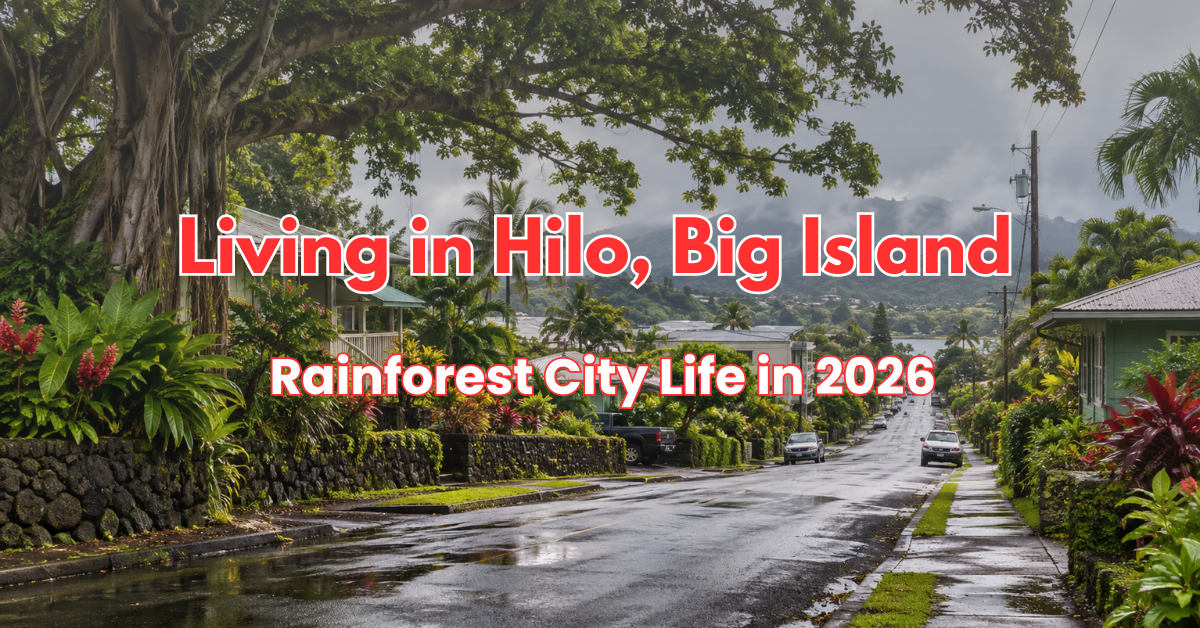
Living in Hilo, Big Island: Rainforest City Life in 2026
When people picture moving to Hawaii, they often imagine golden resort beaches, crowded highways, and high-rise condominiums looking over turquoise surf. Hilo is the complete opposite of that postcard fantasy, and that is precisely why so many people fall in love with it. Nestled on the lush, windward coast of the Big Island, Hilo is an authentic, historic plantation town turned vibrant regional hub. It is a working town wrapped in emerald green rainforest, framed by the sweeping waters of Hilo Bay and the towering peak of Mauna Kea. If you are researching living in Hilo big island 2026, you are likely drawn to its old-Hawaii charm, slower pace, and noticeably lower housing costs compared to Oahu or West Hawaii.
Take the Quiz: Is Hawaii Right For You? Meet with a Living in Hawaii Expert!
Yet moving here requires a grounded understanding of the realities on the ground. Hilo is famous for being one of the wettest cities in the United States, receiving well over 120 inches of rainfall in typical years. That moisture fuels botanical gardens, rushing waterfalls, and lush backyard fruit trees, but it also dictates home maintenance, daily schedules, and personal routines. In this guide, we break down what daily life in Hilo actually looks like in 2026, including neighborhood dynamics, current real estate pricing, employment realities, healthcare infrastructure, and the mindset you need to truly thrive on this side of Hawaii Island.
The Unique Identity of Hilo: Old Hawaii Charm Meets University Town
Hilo serves as the county seat of Hawaii County, giving it a stable civic heartbeat that balances its quiet reputation. Unlike resort-heavy areas like Kailua-Kona or the Kohala Coast, Hilo is driven by local government, education, agriculture, healthcare, and scientific research tied to the world-class observatories on Mauna Kea. The presence of the University of Hawaii at Hilo and Hawaii Community College injects youthful energy, lecture series, student arts, and cultural events into the community year-round.
Architecturally, Hilo retains a distinct historic footprint. Walking along Kamehameha Avenue in Downtown Hilo, you will see wooden storefronts with covered awnings that date back to the early 20th century. These buildings survived devastating tsunamis in 1946 and 1960, which reshaped the coastline and prompted the creation of the expansive Bayfront green space you see today. Because commercial development has been measured and deliberate, you will not find towering glass towers or wall-to-wall chain restaurants. Instead, life revolves around beloved mom-and-pop bakeries, family-owned hardware stores, and roadside fruit stands.
For anyone deciding between different communities on the east side of Hawaii Island, evaluating how Hilo stacks up against nearby rural options is essential. Our Living in Hilo vs Pahoa comparison guide explores how municipal infrastructure and commute patterns differ between the two regions, giving you a clear perspective on which lifestyle matches your goals.
The Hilo Climate Reality: Embracing the Rain
You cannot talk about living in Hilo without talking about rain. Rainfall here is not an occasional disruption. It is the defining environmental characteristic of the region. Hilo averages between 120 and 140 inches of rain annually at sea level, with higher mauka (mountain-facing) neighborhoods receiving even more. However, newcomers often misjudge how this rain behaves. It rarely settles in as an uninterrupted, cold gray drizzle for weeks on end. Most days feature brilliant morning sunshine followed by afternoon trade-wind showers, or heavy rain overnight that clears by dawn.
This distinct climate requires practical lifestyle adjustments. Mold and mildew management becomes a weekly household duty. Dehumidifiers, proper cross-ventilation, and ceiling fans are necessities rather than luxury upgrades. Outdoor gear, vehicles, and garden equipment wear faster due to high humidity and salt air, making rust prevention a constant consideration. If you want to understand how rain shapes daily routines across different island pockets, take a look at our guide to the best rainy day towns in Hawaii.
There is also an undeniable magic to the climate. The trade winds keep air temperatures comfortable, typically hovering between 70 and 83 degrees Fahrenheit year-round. You will rarely need home heating, and many residents get by comfortably without central air conditioning, relying instead on ocean breezes and ceiling fans. The vegetation grows at an astounding pace, meaning your yard will quickly overflow with papaya, bananas, avocados, and vibrant tropical flowers.
Hilo Real Estate and Rental Market in 2026
Real estate affordability has historically been Hilo’s primary draw for mainland relocators. While prices have climbed significantly over the past five years, Hilo remains markedly more accessible than Honolulu, South Maui, or Kailua-Kona. As of 2026, the median sales price for a single-family home in Hilo sits around $530,000 to $575,000, compared to well over $850,000 on the Kona side and over $1,050,000 on Oahu.
Housing stock in Hilo is diverse, though skewed toward older properties. You will find classic mid-century single-wall construction plantation homes, post-and-pier houses designed to catch ground-level breezes, and newer subdivisions built throughout the late 1990s and 2000s in areas like Waiakea. Condominiums exist along Banyan Drive and near the university, but the overwhelming majority of housing consists of detached single-family homes.
Lava Hazard Zones and Home Insurance
One critical technical detail every prospective buyer must understand is lava hazard zoning. The United States Geological Survey divides the Big Island into hazard zones numbered 1 through 9, with Zone 1 representing the highest risk. Most of central Hilo is designated as Lava Hazard Zone 3. Mauna Loa’s historical lava flows have approached Hilo in past centuries, but the municipal core has established risk parameters that allow standard homeowners insurance to remain widely available. This is a crucial distinction from lower Puna neighborhoods located in Zones 1 and 2, where obtaining standard private hazard insurance can be challenging or cost-prohibitive. For an in-depth breakdown of these boundaries and insurance implications, read our guide on living near volcano zones in Hawaii.
Rental Market Realities
Finding a long-term rental in Hilo requires patience and persistence. Due to steady demand from university students, healthcare traveling professionals, and long-term locals, the vacancy rate remains tight. In 2026, a standard two-bedroom apartment or modest rental home typically commands between $1,800 and $2,500 per month, plus utilities. Many landlords prefer in-person meetings before signing leases, which means booking temporary accommodations while you view properties on the ground is almost always necessary.
Neighborhood Deep Dive: Where to Live in Hilo
Hilo offers several distinct micro-neighborhoods, each with its own elevation, rainfall level, and community feel. Finding the right fit depends on whether you prefer proximity to schools, ocean recreation, or secluded greenery.
1. Waiakea: Suburban Convenience and Top Schools
Waiakea forms the suburban core of southern Hilo. It is popular among families and established professionals due to its well-regarded public schools, including Waiakea High School, Waiakea Intermediate, and Waiakea Elementary. The neighborhood sits near major shopping centers, Prince Kuhio Plaza, and grocery outlets.
-
Pros: Consistent municipal infrastructure, connected sidewalks in newer subdivisions, quick access to retail and dining, solid school district reputation.
-
Cons: Homes here carry a price premium over other Hilo sectors. Neighborhoods feel more conventional and suburban, with less historic architectural character.
2. Keaukaha: Coastal Living and Ocean Access
Located along the shoreline east of Hilo Bay and Hilo International Airport, Keaukaha is Hilo’s primary beach neighborhood. It is home to beloved spots like Onekahakaha Beach Park, Carlsmith Beach Park, and Richardson Ocean Park. Fresh spring water mixes with ocean tides along these rocky, black lava coastlines, creating crystal-clear lagoons ideal for snorkeling with green sea turtles.
-
Pros: Direct access to Hilo’s best ocean swimming and paddleboarding, relatively flat terrain perfect for beach cruising, ocean breezes that reduce interior humidity.
-
Cons: A substantial portion of the land in Keaukaha is Hawaiian Home Lands, which is restricted to qualified Native Hawaiian beneficiaries and unavailable on the open market. Open-market parcels and homes are limited and trade at high prices. Proximity to the shipping port and airport means some industrial traffic.
3. Kaumana: Lush Mountain Elevation
Kaumana stretches inland, climbing up the lower slopes of Mauna Loa along Kaumana Drive and Saddle Road. Because of its elevation, Kaumana is noticeably cooler than downtown Hilo, with crisp evening temperatures that make for excellent sleeping weather. Homes here often sit on larger lots surrounded by dense tropical ferns, ohia trees, and flowering gingers.
-
Pros: Cooler climate, peaceful natural surroundings, spacious parcels, and fast access to the Daniel K. Inouye Highway for cross-island commutes to Kona.
-
Cons: Higher rainfall than coastal Hilo, leading to faster moss and mold growth on driveways and roofs. Requires reliance on personal vehicles for every basic errand, as walkable retail does not exist in upper Kaumana.
4. Downtown & Bayfront: Walkable History
Downtown Hilo centers around the historic waterfront business district. Living in or directly adjacent to downtown means you can walk to the famous Hilo Farmers Market, local coffee shops, independent bookstores, the Palace Theater, and civic buildings. Housing options here range from older historic homes on quiet side streets to a handful of apartment buildings.
-
Pros: Walkable lifestyle, rich cultural atmosphere, immediate proximity to dining, events, and community markets.
-
Cons: Parking can be competitive during events like the Merrie Monarch Festival or weekend market days. Older structures frequently require extensive retrofitting, updating, and pest treatment.
Daily Life, Culture, and Community in Hilo
Living in Hilo means embracing a community rhythm that honors tradition, family, and outdoor connection. If you move here expecting rapid mainland pacing, instant gratification, or 24-hour convenience, you will struggle. If you appreciate knowing your postal clerk, waving to neighbors, and pausing to let cars merge into traffic, Hilo will welcome you with open arms.
The Cultural Epicenter of Hula
Hilo is globally recognized as the home of the Merrie Monarch Festival. Held annually the week after Easter, this week-long festival celebrates the art of hula and traditional Hawaiian culture. The town transforms during this period. Accommodations sell out more than a year in advance, artisans travel from every corner of the Pacific to showcase their craftsmanship, and the civic pride throughout the community is palpable. Beyond festival week, cultural centers, museums like the Lyman Museum, and Hawaiian language programs through the university maintain deep roots here.
Healthcare Infrastructure in 2026
Healthcare on the Neighbor Islands has historically faced staffing challenges, but Hilo has seen meaningful investment. Hilo Benioff Medical Center serves as the primary regional healthcare facility, offering acute care, a level III trauma center, and an expanding range of specialty services. Recent facility expansions funded by public-private partnerships have added modern surgical suites and intensive care beds. That said, residents with rare or highly specialized medical conditions should recognize that complex treatments may still require occasional specialist flights to Oahu.
Groceries, Dining, and Local Agriculture
Eating well in Hilo is remarkably satisfying if you adapt your diet to the land. The Hilo Farmers Market operates every day, with massive peak market days on Wednesdays and Saturdays. Here you can buy tropical fruits, locally grown greens, ginger, taro, and fresh fish for a fraction of mainland supermarket prices. Supermarket options include Safeway, KTA Super Stores (a beloved island institution featuring local foods and cuts), Target, and Walmart. Big box bulk shopping requires a trip to the Kona side for Costco, which many Hilo families turn into a scheduled monthly cross-island supply run.
The Practical Challenges of Living in Hilo
We believe in full transparency when discussing any move to Hawaii. While Hilo offers an enviable lifestyle, several realities cause unprepared newcomers to leave within their first two years.
1. Mold, Mildew, and Rust
With high humidity and steady rainfall, homes require vigilant upkeep. Power-washing driveways and decks is an annual ritual. Leather shoes, coats, and cardboard storage boxes kept in dark closets can develop mildew quickly if not stored with moisture absorbers or adequate airflow. Modern vehicles parked outdoors near the ocean face paint and undercarriage wear.
2. The Coqui Frog Chorus
If you have never experienced the coqui frog, prepare your ears. These tiny invasive tree frogs emit a piercing two-tone mating call that easily reaches 80 to 90 decibels. In dense residential areas with lush foliage, thousands of frogs call simultaneously from dusk until dawn. While many long-time residents find the sound soothing white noise, newcomers often struggle with sleepless nights initially. Earplugs, sound machines, or carefully managed yard foliage are standard coping strategies.
3. The Job Market
Hilo’s economy is stable but not vast. Major employers include county and state government, the Department of Education, the University of Hawaii, Hilo Benioff Medical Center, agricultural businesses, and local service industries. Remote workers moving from the Mainland have found a comfortable niche in Hilo thanks to high-speed fiber internet availability in most town neighborhoods, but finding high-paying corporate roles on the ground is rare. Networking, professional humility, and patience are necessary when searching for local employment.
4. Cross-Island Commutes
Kailua-Kona sits on the opposite side of the island. The Daniel K. Inouye Highway (commonly called Saddle Road) connects Hilo to the west side across the high plateau between Mauna Kea and Mauna Loa. While the modernized highway has cut driving times down to approximately 75 to 90 minutes, it remains a serious cross-island drive subject to sudden fog, high winds, and heavy rain. Those who attempt to live in Hilo while working daily in Kona resort areas often find the three-hour round-trip commute exhausting over time.
Is Living in Hilo in 2026 Right for You?
Choosing Hilo is a deliberate decision to prioritize lifestyle, community, and green natural landscapes over commercial nightlife, endless dry beaches, and fast-paced city life. It is a city that invites you to slow down, cook at home, join community cleanups, and spend rainy Sunday afternoons reading on a covered lanai while listening to water hit corrugated metal roofs.
If you are someone who needs constant sunshine, designer retail, and bustling night clubs, Hilo will likely feel too quiet, wet, and isolated. But if you value rich Hawaiian history, warm neighbors, lush outdoor recreation, and a town where people still take the time to talk story, living in Hilo on the Big Island in 2026 might be the most rewarding move of your life.
Leave A Comment