

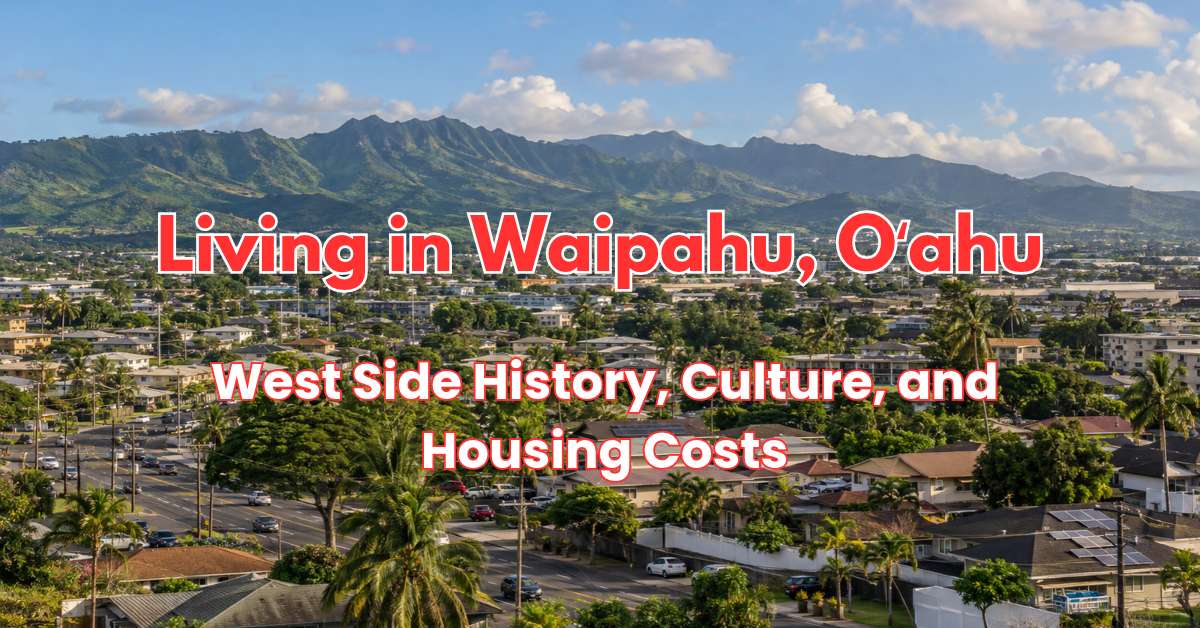
Living in Waipahu, Oʻahu: West Side History, Culture, and Housing Costs
When people think about relocating to Oʻahu, their minds often drift toward the postcard images of Waikīkī beachfronts, the wind-swept hillsides of Kailua, or the brand-new master-planned developments springing up across Kapolei. Yet tucked along the northern shore of Pearl Harbor’s West Loch lies Waipahu, a community that carries the authentic heartbeat of working-class Oʻahu. It is an area defined by deep plantation roots, multi-generational family ties, world-class culinary hidden gems, and some of the most competitively priced residential real estate on the island.
Take the Quiz: Is Hawaii Right For You? Meet with a Living in Hawaii Expert!
Living in Waipahu offers a perspective on island life that short-term visitors almost never experience. It is busy, culturally rich, unapologetically unpretentious, and centrally positioned for commuters who need to traverse between the Ewa plain, Central Oʻahu, and downtown Honolulu. In this deep dive, we break down what daily life in Waipahu actually looks like, how the community evolved from a bustling sugar mill settlement into a modern transit hub, what you can expect to pay for housing, and whether this dynamic slice of West Oʻahu matches your relocation goals.
The Historic Roots of Waipahu: From Sugar Mill to Urban Hub
To understand Waipahu today, you have to understand the Oahu Sugar Company. In the Hawaiian language, the name Waipahu translates roughly to “bursting water,” referencing the natural artesian springs that once gushed across the landscape and made the soil exceptionally fertile. In 1897, industrial sugar production arrived with the founding of the Oahu Sugar Company mill. For nearly a century, that mill served as the economic anchor of the entire district, drawing waves of contract laborers from across the globe.
First came workers from China and Portugal, followed by substantial numbers from Japan, Puerto Rico, Korea, and the Philippines. Each group established roots in specific plantation camp clusters scattered around the mill. The cultural traditions, foods, and community organizations established during those intense decades formed the cultural foundation that still defines the community today. Even though the sugar mill permanently shut down its operations in 1995, the historic 175-foot mill smokestack still rises into the skyline as a proud monument to the generations of workers who built modern Hawaiʻi.
Today, that heritage is preserved hands-on at Hawaii’s Plantation Village, an outdoor living history museum located along Waipahu Cultural Garden Park. Walking through the restored camp houses, community halls, and plantation gardens provides essential context for any newcomer. Waipahu did not grow out of a recent tourism boom or luxury resort development. It grew out of sweat, neighborhood solidarity, and a shared history of immigrant perseverance.
The Neighborhood Geography: Understanding the Layout
Waipahu is not a single uniform neighborhood. Geographically, it stretches from the coastal wetlands of Middle and West Loch up into the gentle foothills that border Central Oʻahu. When people talk about living in Waipahu, they are generally referring to three distinct sections, each with its own character, housing stock, and price point.
Lower Waipahu and the Old Mill Town
Lower Waipahu surrounds Farrington Highway and Waipahu Depot Road. This is the historic core of the town, characterized by vintage single-wall wooden plantation cottages, compact mid-century apartment complexes, mom-and-pop storefronts, and lively commercial strips. Streets here can be narrow, street parking is frequently at a premium, and the sensory energy is high. If you want walkability to grocery markets, transit stops, and independent bakeries, Lower Waipahu is where you will find it.
Waipahu Triangle and Village Park
Moving slightly mauka (toward the mountains) and west, you reach residential enclaves such as Village Park (also known as Honowai). Developed largely during the late 1970s and 1980s, Village Park features cul-de-sacs of single-family homes that climb up the hillside toward Kunia Road. Because of the elevation, many homes here catch cool tradewinds and enjoy sweeping, panoramic views across Pearl Harbor and toward Diamond Head. It offers a quieter, purely residential setting compared to the bustling commercial corridors down below.
Waipio Gentry and Waikele
While technically designated as separate census tracts or planned communities, both Waipio Gentry and Waikele fall under the greater Waipahu postal and regional umbrella. Waipio Gentry features master-planned subdivisions and townhome communities built in the 1980s and 1990s, offering neighborhood parks, shopping plazas, and direct access to Kamehameha Highway. Just across the H-1 freeway sits Waikele, famous for the Waikele Premium Outlets, manicured golf course greens, tree-lined sidewalks, and executive-style single-family homes. Buyers seeking a manicured suburban aesthetic usually gravitate toward Waikele, while those prioritizing budget, lot size, or transit proximity look closer to Lower Waipahu and Village Park. For buyers exploring evolving communities across the island chain, comparing Waipahu with the best up-and-coming neighborhoods in Hawaii can help clarify how this submarket stacks up against emerging options elsewhere.
Cost of Living and Housing Realities
Housing affordability on Oʻahu is a notorious challenge, but Waipahu consistently provides one of the more accessible entry points for both homebuyers and renters without pushing you out to the furthest points of the Leeward Coast.
Single-Family Homes
As of 2026, the median sales price for a single-family home across Oʻahu hovers around 1.1 million dollars. In Waipahu proper, particularly in the older neighborhoods, you can regularly find older three-to-four-bedroom single-family homes trading between $825,000 and $975,000. Many of these properties were constructed between 1950 and 1975. While they may require modern electrical updates, new plumbing, or cosmetic renovations, they frequently sit on generous lots measuring 5,000 to 7,500 square feet.
In higher-elevation neighborhoods like Village Park or up in master-planned Waikele, single-family home prices generally span from $950,000 to over $1,350,000, reflecting larger square footage, two-car enclosed garages, central air conditioning, and planned association maintenance.
Condominiums and Townhomes
For first-time buyers and downsizers, townhomes and condominiums represent the real value play in Waipahu. Older walk-up condominium units in Lower Waipahu can still be purchased in the $250,000 to $380,000 range. However, buyers must be vigilant regarding building reserves, maintenance fee schedules, and assigned parking spaces.
In Waipio Gentry and Waikele, modern two- and three-bedroom townhomes typically trade between $475,000 and $650,000. These complexes frequently include community amenities like swimming pools, clubhouses, and designated guest parking, making them popular among military families stationed at Joint Base Pearl Harbor-Hickam or Schofield Barracks.
The Rental Market
Long-term rental rates in Waipahu reflect its practical, working-class orientation. While luxury high-rises in Kakaʻako command steep premiums, rental options in Waipahu offer practical space for reasonable prices:
-
One-Bedroom Apartments: Typically rent between $1,550 and $1,950 per month, depending on building age and renovation quality.
-
Two-Bedroom Condos and Townhomes: Range from $2,100 to $2,700 per month.
-
Three-Bedroom Single-Family Homes: Generally lease between $3,200 and $4,200 per month, frequently including a private yard and carport.
If you are relocating and planning to lease first before buying, take time to study our comprehensive guide on finding long-term rentals in Hawaii to navigate application requirements, security deposits, and inventory seasons.
Daily Life, Food, and Community Culture
The cultural pulse of Waipahu is vibrant, authentic, and unmistakably grounded in community. It is widely recognized as the cultural capital of the Filipino diaspora in Hawaiʻi, particularly the Ilocano community. That heritage is reflected in everyday life, from storefront banners to weekend youth sporting events.
Culinary life in Waipahu is exceptional if you appreciate authentic, home-style regional cooking over tourist-oriented dining. Along Farrington Highway and inside local commercial strips, you will find independent bakeries producing hot pandesal, ensaymada, and Spanish rolls fresh out of the oven every morning. Local institutions serve up steaming bowls of pork adobo, pinakbet, lechon kawali, and halo-halo. Beyond Filipino cuisine, Waipahu offers outstanding mom-and-pop noodle shops, traditional Hawaiian plate lunch counters, Samoan delis, and classic drive-ins serving teriyaki beef and shave ice.
Community life centers on family and church gatherings. Weekends find parks such as Hans L’Orange Field alive with youth baseball, soccer, and softball tournaments. Hans L’Orange has a storied history of hosting local and collegiate baseball, carrying a nostalgic stadium feel that echoes through the neighborhood. Neighbors talk story across fences, share backyard mangos and papayas, and gather in carports for family milestone celebrations.
Transportation, Traffic, and the Skyline Rail Revolution
No honest guide to living in Waipahu can ignore transportation. For decades, the morning commute into downtown Honolulu was the central drawback of living in West Oʻahu. The stretch of the H-1 freeway known as the “zipper lane corridor” through Pearl City and Waipahu sees dense congestion during peak weekday rush hours.
However, Waipahu has become the epicenter of Oʻahu’s public transit transformation courtesy of the Skyline light rail system. The town features two prominent rail stations:
-
Pouhala Station: Located near Waipahu High School and the Farrington Highway corridor, serving Lower Waipahu and neighborhood commercial centers.
-
Hōʻaeʻae Station: Situated near West Loch and the Leeward Community College border, providing access for commuters and students alike.
The rail offers reliable, air-conditioned transit westward toward Kapolei and eastward through Aloha Stadium, with ongoing route expansions connecting commuters directly toward the airport, Kalihi, and urban Honolulu. For residents working at the university, regional government offices, or surrounding commercial hubs, the rail has eliminated miles of stop-and-go highway stress. For a deeper breakdown of how vehicles, public transit, and highway patterns function across the islands, explore our complete Hawaii transportation guide.
Local Schools, Parks, and Community Infrastructure
Waipahu operates within the Hawaii Department of Education’s Campbell-Kapolei-Waipahu complex area. Waipahu High School is one of the largest high schools in the state and has gained statewide recognition for its nationally certified Career Academy programs. Students can choose specialized career learning tracks covering engineering, health sciences, information technology, culinary arts, and natural resources, often earning college credits while still in high school.
Several public elementary schools serve the community, including Waipahu Elementary, August Ahrens Elementary, and Honowai Elementary, alongside Waipahu Intermediate School. Additionally, Leeward Community College sits immediately adjacent to Waipahu along the Pearl Harbor shoreline, offering two-year associate degrees, vocational training programs, and community enrichment courses.
For outdoor recreation, the Pearl Harbor Historic Trail runs along the shoreline, offering a dedicated path for walking and cycling with views of the lochs. Central Oahu Regional Park, located just minutes mauka along Kamehameha Highway, is a massive 269-acre recreational complex featuring twenty tennis courts, a championship baseball stadium, numerous soccer fields, an aquatic center with an Olympic-sized pool, and archery ranges.
Pros and Cons of Living in Waipahu
Every community on Oʻahu comes with trade-offs. Living in Waipahu means balancing genuine community benefits with the everyday realities of a dense, older suburban area.
The Pros
-
Relative Affordability: Median home and condo prices consistently run lower than neighboring Pearl City, Aiea, or East Honolulu, giving buyers more square footage per dollar.
-
Exceptional Public Transit: With two operational Skyline stations and extensive bus routes along Farrington Highway, transit connectivity is among the best on the island.
-
Deep Community Roots: You will experience an authentic, supportive local culture that is not tailored around resort tourists or seasonal vacation rentals.
-
Central Island Placement: Convenient highway access allows you to reach both the North Shore beaches and South Shore business districts in thirty to forty-five minutes outside of peak rush hours.
-
Incredible Food Culture: Access to independent local markets, ethnic grocery stores, authentic bakeries, and unpretentious neighborhood eateries.
The Cons
-
Freeway Congestion: Eastbound morning commutes and westbound afternoon drives along the H-1 corridor can be grueling if you work standard corporate hours in town.
-
Older Infrastructure: Many residential pockets in Lower Waipahu feature overhead power lines, narrow roadways, lack of sidewalks, and aging drainage systems that can see ponding during heavy rain events.
-
Street Parking Shortages: Multi-generational households are common in Waipahu, meaning many single-family properties have three or four family vehicles, making on-street neighborhood parking competitive.
-
Warmer Temperatures: Located leeward of the Koʻolau range, Waipahu receives plenty of sunshine and can feel noticeably warmer and more humid during mid-summer months than windward towns like Kailua or Kaneohe.
Is Waipahu the Right Place for You?
Waipahu is an ideal fit for buyers and renters who want an authentic, grounded community experience and value practical affordability over trendy nightlife. It appeals strongly to multi-generational households, healthcare workers commuting to nearby Queen’s Medical Center West Oʻahu or Pali Momi, military personnel needing central placement between Leeward and Central bases, and anyone who appreciates living among working families who take pride in their heritage.
If you require walkable boutique beach towns, immediate oceanfront views, or modern luxury planned developments with strict architectural guidelines, areas like Kailua or Ko Olina may better match your expectations. But if you want a neighborhood with soul, deep historical roots, unmatched ethnic food, and realistic housing pricing that keeps the island dream within practical reach, Waipahu deserves serious consideration on your Oʻahu home search.
Leave A Comment