

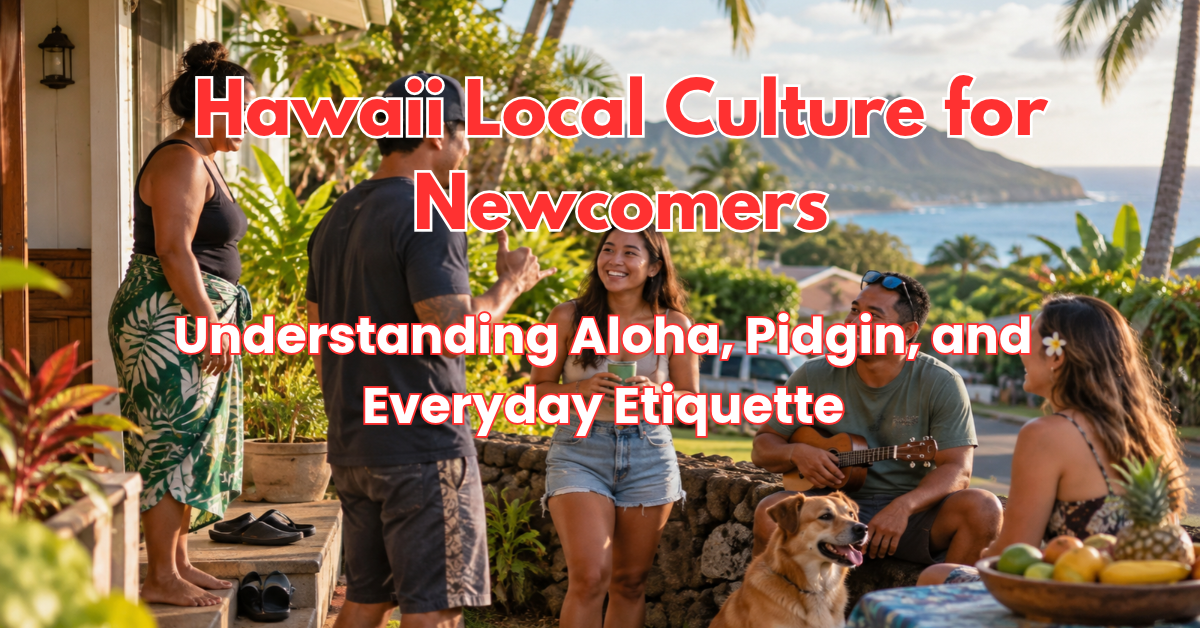
Hawaii Local Culture for Newcomers: Understanding Aloha, Pidgin, and Everyday Etiquette
Moving across the Pacific brings a major shift in geography, but the greatest adjustment for most newcomers is cultural. Hawaii is often portrayed through glossy travel magazines as a perpetual resort vacation, yet everyday life here operates within a nuanced, rich cultural ecosystem shaped by Native Hawaiian heritage and generations of plantation-era immigration. Understanding Hawaii local culture for newcomers is not about learning party tricks or collecting beach slang. It is about understanding how to carry yourself with humility, respect, and awareness in a close-knit island community.
Take the Quiz: Is Hawaii Right For You? Meet with a Living in Hawaii Expert!
When you relocate from the Mainland, your instinct might be to bring the same pace, assertiveness, and conversational habits that served you well in fast-moving cities. In the islands, however, those exact traits can come across as aggressive, self-centered, or dismissive. Building a peaceful and fulfilling life here requires shifting your mindset from consuming the island experience to participating thoughtfully in the community. As you settle into your new home, learning the unwritten social expectations will make all the difference in how warmly you are received by your neighbors, coworkers, and friends.
The Core of Island Life: Moving Beyond the Commercial Aloha Spirit
Most visitors encounter the concept of Aloha on promotional posters, retail storefronts, and airport greeting signs. Commercial marketing has reduced the word to a breezy substitute for hello, goodbye, or casual warmth. In reality, the concept runs much deeper. Under Hawaii state law, the Aloha Spirit is codified as a set of guiding principles, recognizing the depth of character required to live collaboratively on an isolated landmass with limited space and resources.
Historically, the term originates from Native Hawaiian philosophy, describing mutual regard, care, and the shared breath of life. In everyday modern life, practicing this mindset means leading with patience and assuming the best of others. It means yielding when driving on narrow residential roads, checking in on elderly neighbors after heavy rains, and prioritizing people over schedules. If you approach everyday interactions with transactional impatience, you will quickly find that doors stay closed. Island life operates on relational capital, not transactional speed.
For anyone striving toward building community fast after moving to Hawaii, genuine humility is your greatest asset. You are entering a society where multi-generational families have shared schools, church halls, beaches, and funeral gatherings for decades or centuries. Taking the time to listen before you speak, asking questions instead of offering unsolicited solutions, and recognizing your role as a newcomer demonstrates the respect that local residents appreciate.
Hawaiian Creole English (Pidgin): How to Navigate the Island Language
One of the most immediate cultural dynamics you will encounter is Hawaiian Creole English, known universally across the islands as Pidgin. Developed during the 19th-century sugar and pineapple plantation era, Pidgin emerged as a shared communication bridge between Native Hawaiians, Caucasian managers, and immigrant laborers from China, Portugal, Japan, the Philippines, Korea, and Puerto Rico. Today, Pidgin is recognized as an official creole language with its own distinct grammatical structure, rhythm, and vocabulary.
As a newcomer from the Mainland, navigating Pidgin requires clear boundaries. Here is the single most important rule: do not try to speak Pidgin. When newcomers force phrases like “da kine” or attempt to copy the local intonation, it sounds artificial, caricatured, and offensive, even when well-intentioned. Local residents know that Pidgin is an earned, identity-rooted linguistic code. Using it when it is not your native voice creates immediate social friction.
The Golden Rules of Linguistic Etiquette
-
Listen and understand, but respond in your natural voice: It is helpful to learn common terms so you understand what is being said around you, but always reply in standard English using your authentic accent and tone.
-
Never correct someone speaking Pidgin: Pidgin is not broken English. Treating it as improper speech demonstrates linguistic ignorance and disrespect toward centuries of local working-class history.
-
Pronounce Hawaiian place names correctly: While you should avoid mimicking Pidgin slang, you must make a genuine effort to pronounce Hawaiian place names, street names, and town names correctly. Learn the basic vowel sounds (ah, eh, ee, oh, oo) and pay attention to the okina (glottal stop) and kahako (macron).
-
Ask politely if you do not understand: If a contractor, neighbor, or vendor uses a local term that leaves you confused, a simple and polite clarification works best. A respectful attitude is always welcome.
Understanding the linguistic landscape takes time. If you focus on clear, considerate communication without putting on an act, people will recognize your authenticity and engage with you in good faith.
The Unwritten Rules of the Hawaii Home
Domestic life in Hawaii follows specific protocols that keep homes clean, peaceful, and hospitable. When you step across someone’s threshold, you are entering a sanctuary designed around shared respect and climate realities.
Remove Your Shoes at the Door
Taking your shoes or slippers off before stepping into a residence is mandatory. This practice, brought to the islands by Asian immigrant communities and embraced by all cultures here, is both practical and symbolic. It keeps red dirt, sand, and outdoor grime from entering living areas, while signaling respect for the host’s private space. When approaching any home, look near the front door. You will almost always see a neatly arranged row of footwear. Slide your shoes or slippers off, leave them neatly by the entryway, and step inside barefoot or in socks.
Never Arrive Empty-Handed: The Tradition of Omiyage
Generosity is an active, visible currency in island culture. Arriving at a friend’s, neighbor’s, or coworker’s house empty-handed is considered bad form. This practice connects directly to the Japanese tradition of omiyage (gift-giving) and general Polynesian customs of sharing sustenance.
Your gift does not need to be expensive or elaborate. In fact, simple edible gifts are preferred. Excellent everyday offerings include:
-
A box of pastries from a local bakery
-
Fresh fruit from your yard or a roadside market
-
Poke from your neighborhood fish market
-
Specialty snacks purchased during trips back to the Mainland
-
A case of juice, sparkling water, or beer for an informal gathering
Similarly, when someone offers you food or a cold beverage when you visit their home, accept it graciously. Declining hospitality can be perceived as aloofness. If you are preparing to ship household goods and settle in, reviewing advice on how to downsize for a move to Hawaii will help you organize your domestic space to host neighbors comfortably without unnecessary clutter.
Everyday Etiquette: The Road, the Grocery Store, and the Beach
The pacing of public spaces in Hawaii is distinctly different from the Mainland. When you are out in public, you are sharing finite resources with people you will inevitably cross paths with again. Anonymity is rare on an island.
Driving Etiquette: The Gentle Island Commute
Driving on island roads requires a complete recalibration if you are used to aggressive metropolitan highways. Island driving revolves around collective cooperation rather than asserting your right-of-way.
-
Honking is strictly for emergencies: Leaning on your horn because someone hesitated at a green light or took an extra moment to merge is viewed as an act of hostility. Save the horn exclusively to prevent an imminent collision.
-
Let people merge: Because island infrastructure often forces busy traffic onto two-lane highways or narrow neighborhood corridors, letting cars cut into the flow of traffic is expected. Practice the zipper merge patiently.
-
The Shaka or Wave of Thanks: When another driver yields to let you into their lane, always offer a friendly wave, a shaka, or a nod of acknowledgment in your rearview mirror. Ignoring the courtesy is considered poor etiquette.
-
Drive slower in residential areas: Many neighborhoods do not have sidewalks. Children, kupuna (elders), and pets walk along the shoulder. Always obey posted speeds and slow down well below the limit when passing pedestrians.
The Art of “Talk Story”
In many Mainland cities, public interactions are transactional. You buy your groceries, pick up your coffee, pay your dry cleaner, and leave without unnecessary conversation. In Hawaii, relationship comes before transaction. The cultural practice known as “talking story” refers to casual, unhurried conversation that builds connection.
When a store clerk, postal worker, or neighbor asks how your day is going, they often expect a genuine, friendly response rather than a hurried nod. Taking sixty seconds to chat about the weather, share a laugh, or ask about their day is an essential part of daily life. If you rush through every interaction as if you are late for a board meeting, you will isolate yourself from the community. Slow down, breathe, and embrace the human connection in front of you.
Beach and Ocean Protocol
The ocean is central to Hawaii culture, recreation, and spiritual life. It is not merely an outdoor playground; it is a powerful natural environment that demands deference and awareness.
-
Respect the wildlife: Federal and state laws strictly protect honu (green sea turtles), Hawaiian monk seals, and spinner dolphins. Always maintain safe, legal distances (typically at least 10 feet for turtles and 50 feet for monk seals). Crowding an animal for a smartphone photo displays profound disrespect.
-
Pack out your trash: Never leave plastic wrappers, bottle caps, or food containers on the beach. If you see litter left by others, pick it up. Keeping beaches pristine is a shared community obligation.
-
Do not touch the coral reefs: Coral heads are living, delicate marine ecosystems that take decades to grow. Never stand on, kick, or grab coral. Wear reef-safe mineral sunscreen (zinc oxide or titanium dioxide) to protect ocean clarity and marine health.
-
Know your limits before paddling out: If you are learning to surf, bodyboard, or paddle, choose beginner-friendly breaks. Do not paddle out into crowded lineups at advanced breaks. Surfing etiquette is enforced strictly by experienced watermen, and dropping in on someone’s wave or losing control of your board creates dangerous conditions.
Pros and Cons: Navigating Hawaii Local Culture as a Newcomer
Adjusting to the cultural fabric of Hawaii brings both immense rewards and real challenges. Here is an honest assessment of what newcomers experience during their first several years on the islands.
The Pros
-
A deeply supportive community environment: When you earn the trust of your neighbors, you will experience an authentic safety net. People share yard produce, watch over each other’s homes, and rally to help during storms or family emergencies.
-
Lower baseline stress in daily public interactions: The unhurried pace, polite driving culture, and frequent smiles make daily errands substantially less abrasive than in major Mainland metropolitan areas.
-
Exposure to rich multi-ethnic traditions: Living in Hawaii offers continuous opportunities to participate in cultural festivals, culinary traditions, and community celebrations spanning Hawaiian, Japanese, Filipino, Samoan, and other heritages.
-
A healthy, outdoor-centered family lifestyle: Children raised here learn to respect nature, swim, hike, and enjoy an active community life surrounded by supportive elders and extended family networks.
The Cons and Challenges
-
The feeling of being on probation: Because so many Mainland transplants leave after one to two years due to cost of living or homesickness, local residents may keep an emotional distance until you show genuine staying power. It can take months or years to build deep friendships.
-
Pacing friction: If you are accustomed to rapid contractor responses, immediate delivery turnarounds, and ruthless workplace efficiency, the slower island rhythm can cause significant initial frustration.
-
Navigating complex social and historical sensitivities: Hawaii has a painful history regarding the overthrow of the Hawaiian Kingdom, land loss, and displacement. Thoughtless political opinions or naive historical commentary from newcomers can cause real offense.
-
Social accountability: On an island, your reputation travels fast. A dispute with a contractor, an argument with a neighbor, or rude behavior in a restaurant will echo across social circles. You cannot simply reinvent yourself across town.
Respecting the Land and Culture: Becoming a Thoughtful Contributor
The Hawaiian proverb “He alii ka aina; he kauwa ke kanaka” translates to: “The land is a chief; man is its servant.” This philosophy underscores the traditional understanding of stewardship, or malama aina (caring for the land). When you live here, you are not simply residing on real estate; you are living within a delicate island ecosystem that requires protection.
Getting involved in local community efforts is one of the best ways to show your commitment to the islands. Volunteer with local non-profit groups that restore native taro patches (loi), clear invasive species from mountain hiking trails, or clean coastal shorelines. Showing up with work gloves, a water bottle, and a willingness to do manual labor alongside long-time residents demonstrates your dedication far more effectively than words ever could.
As you explore potential places to settle, researching the best up-and-coming neighborhoods in Hawaii can give you valuable context on how local communities evolve, where infrastructure is growing, and how different regions balance residential life with cultural preservation.
The Long-Term Path: Earning Your Place in the Island Ohana
Becoming an accepted, respected member of an island community does not happen overnight. It is an organic process built across hundreds of small, quiet moments: returning a lost tool, waving to the mail carrier, showing patience at the checkout counter, and listening when an elder shares a story about how the neighborhood looked forty years ago.
Leave behind the impulse to compare everything to how it was done back on the Mainland. Avoid beginning sentences with “Back home, we used to…” Hawaii has its own systems, rhythms, and community values that have sustained its people across generations. If you approach your new life with gratitude, modesty, and an open heart, you will discover that the Aloha Spirit is not a tourist slogan. It is a real, living, and profound way to walk through the world.
Leave A Comment